Band Face Pull
Posterior Chain • Shoulder Health • Postural Correction
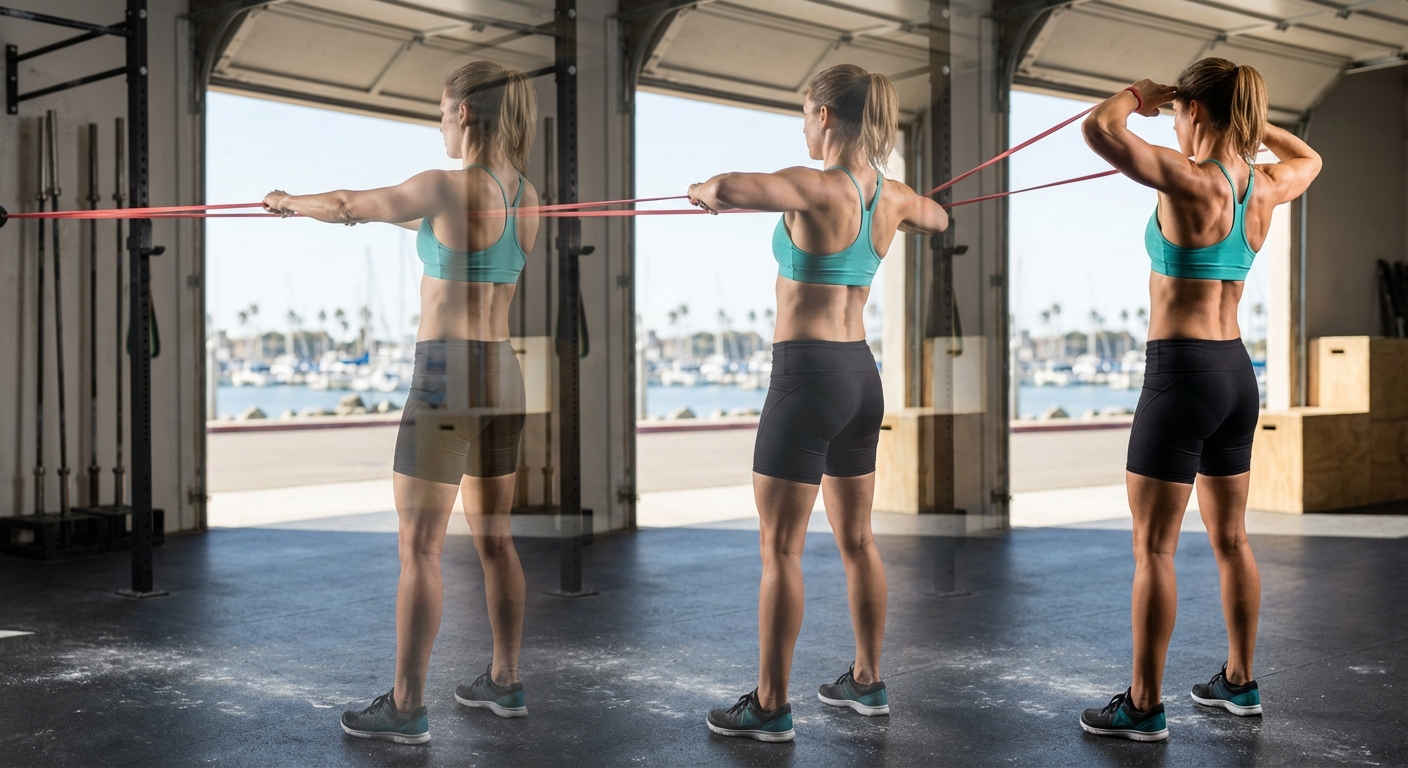
Biomechanics Analysis
Kinetic Chain & Force Vectors
The Band Face Pull operates as an Open Kinetic Chain movement. While the feet remain fixed to the floor providing a stable base, the distal segments (hands) move freely against the variable elastic resistance of the band.
The resistance vector is horizontal and anterior. As the band stretches, the tension increases linearly according to Hooke's Law (F = k × x), matching the ascending strength curve of the scapular retractors. The user must generate a posterior force vector while simultaneously managing an external rotation torque at the shoulder.
Joint Mechanics & Torque
Primary Pivot: The Glenohumeral (Shoulder) Joint executes horizontal abduction (θ ≈ 45° → 90°) coupled with external rotation. This specific combination maximizes recruitment of the rotator cuff.
Secondary Pivot: The Humeroulnar (Elbow) Joint transitions from full extension to approximately 90° flexion. Stability relies heavily on the "Pillar" (Thoracic/Lumbar Spine), where the Rectus Abdominis must produce anti-extension torque (τ) to counteract the anterior pull of the band.
Muscle Activation Map
Primary Movers
- Posterior Deltoid
- Infraspinatus
- Teres Minor
Synergists
- Rhomboids (Major & Minor)
- Middle Trapezius
- Brachialis
Global Stabilizers
- Rectus Abdominis
- Obliques
- Gluteus Maximus
Execution Protocol
Anchor Setup
Secure the resistance band to a stable vertical post at roughly eye level or slightly above. A higher anchor point encourages better external rotation mechanics.
Stance & Grip
Grasp the band with a neutral or overhand grip (palms facing down or in). Step back to create tension. Adopt a staggered or athletic stance, engaging the glutes and core to lock the ribcage down.
The Pull Phase
Initiate by driving the elbows back and wide. As the elbows pass the plane of the torso, externally rotate the shoulders so your hands end up in a "double bicep" pose position beside your ears.
Peak Contraction
Squeeze the scapulae together without shrugging the upper traps. Hold for 1 second to maximize time under tension (TUT) at the point of highest mechanical disadvantage.
Eccentric Return
Control the return phase. Do not let the band snap your arms forward. Maintain scapular depression as you extend the elbows back to the start position.
Technical Faults Analysis
| Error | Biomechanical Consequence | Correction |
|---|---|---|
| Elbows Dropping | Shifts load from the posterior delt/rotator cuff to the Lats; reduces external rotation torque. | Keep elbows high, aiming to pull the band apart horizontally. |
| Forward Head Posture | Cervical spine extension acts as a false fulcrum, stressing neck extensors. | Tuck the chin (cervical retraction) throughout the movement. |
| Lumbar Hyperextension | Indicates failure of the anterior core (Rectus Abdominis) to stabilize the pelvis. | Squeeze glutes and "crunch" the ribs down before initiating pull. |
| Upper Trap Dominance | Scapular elevation occurs instead of retraction/depression, causing neck tension. | Focus on "putting the shoulder blades in the back pockets." |