Band Overhead Press
Shoulder Hypertrophy • Scapular Stability • Accommodating Resistance
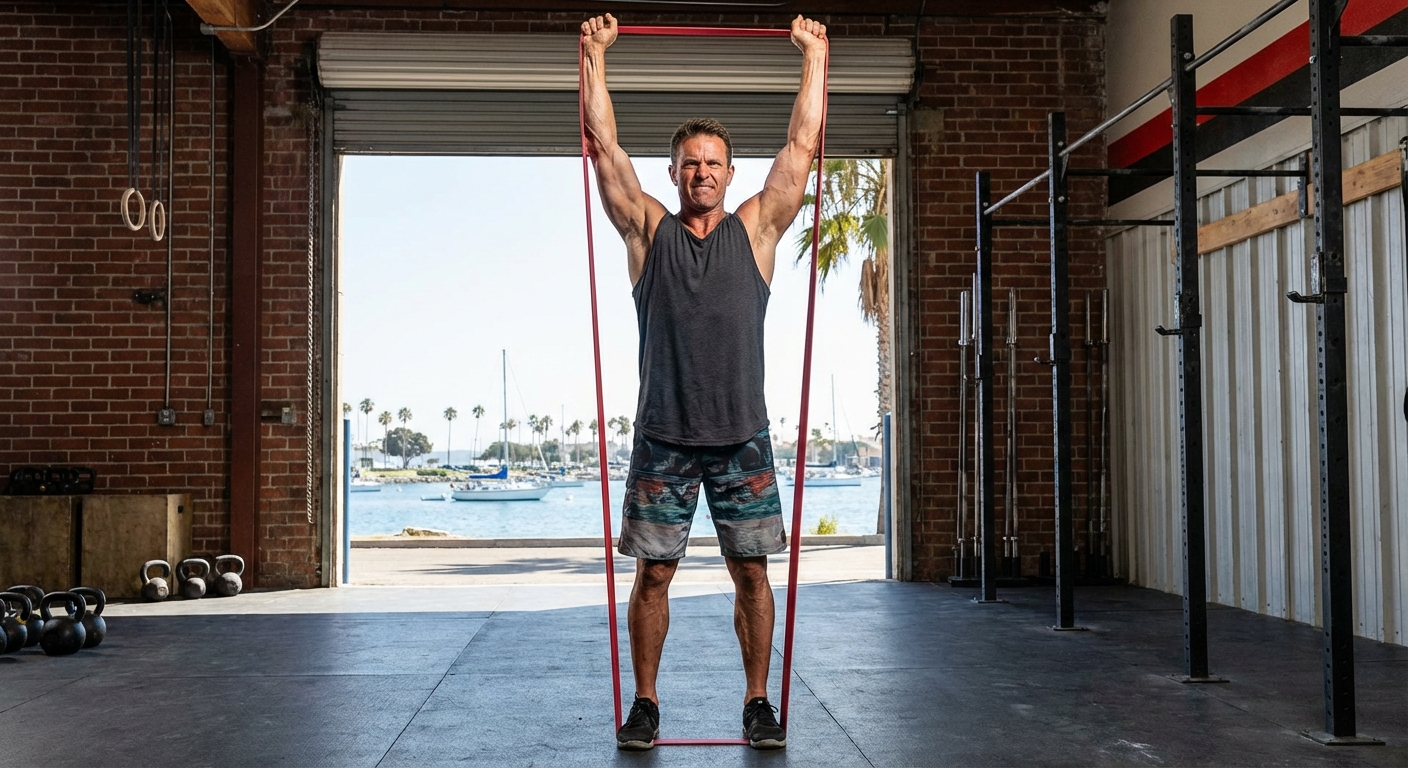
Biomechanics Deep Dive
1 Kinetic Chain Dynamics
This movement utilizes a Closed Kinetic Chain anchor at the feet to transfer Ground Reaction Forces (GRF) through a rigid trunk, transitioning to an Open Kinetic Chain in the upper extremities.
Unlike gravity-based weights, force transmission relies on linear elastic tension (F = kΔx). This creates an ascending resistance curve. Peak torque is experienced at full elbow extension (180° flexion), demanding maximum motor unit recruitment at the range of motion where mechanical advantage is typically highest.
2 Vector Analysis & Stability
The elastic band creates a distinct line of pull that differs from a vertical barbell vector. The band pulls downward and slightly backward towards the anchor point (feet).
This generates a significant anterior shear force vector on the lumbar spine. To prevent lumbar lordosis (extension angle θ > neutral), high-threshold recruitment of the Rectus Abdominis and Gluteus Maximus is mandatory for 'anti-extension' stability.
Joint Articulation & Range
Muscle Map
Primary Movers
- Anterior Deltoid
- Medial Deltoid
- Triceps Brachii
Synergists
- Clavicular Pectoralis Major
- Upper Trapezius
- Serratus Anterior
Stabilizers
- Rotator Cuff Complex
- Rectus Abdominis
- Gluteus Maximus
Step-by-Step Execution
Anchor Setup
Stand on the center of the resistance band with feet shoulder-width apart. Ensure equal length of the band on both sides to maintain symmetrical load (Fleft = Fright).
The Rack Position
Bring the bands to shoulder height. Palms should face forward or slightly inward (neutral bias). Elbows must be directly under the wrists, creating a vertical forearm vector. Brace the core heavily to neutralize lumbar extension.
Concentric Phase
Drive the hands vertically. As the band stretches, resistance increases linearly. Exhale forcefully through the sticking point. Aim to bring the biceps toward the ears at the top, ensuring full scapular upward rotation.
Eccentric Control
Lower the band slowly under control. Do not let gravity and elasticity snap the arms down. Resist the band's pull to maximize time under tension (TUT) and eccentric muscle damage for hypertrophy.
Common Mistakes & Corrections
| Error | Biomechanical Consequence | Correction |
|---|---|---|
| Lumbar Hyperextension (Rib Flare) | Inefficient force transfer; increased shear stress on lumbar vertebrae (L4-L5). | Squeeze glutes and brace abs (Valsalva maneuver) to lock ribcage down. |
| Forward Pressing Angle | Increases moment arm on the anterior deltoid but reduces vertical drive efficiency; limits ROM. | Press directly overhead. Head should move slightly forward "through the window" at the top. |
| Internal Rotation at Lockout | Increases risk of subacromial impingement by reducing subacromial space. | Think about "showing your armpits" to the front at the top of the movement. |
| Rapid Eccentric Drop | Loss of tension; relies on connective tissue elasticity rather than muscle control. | Control the descent for 2-3 seconds to maximize mechanical tension. |