Band Pull Aparts
A fundamental corrective exercise for scapular stability, shoulder health, and posterior chain activation.
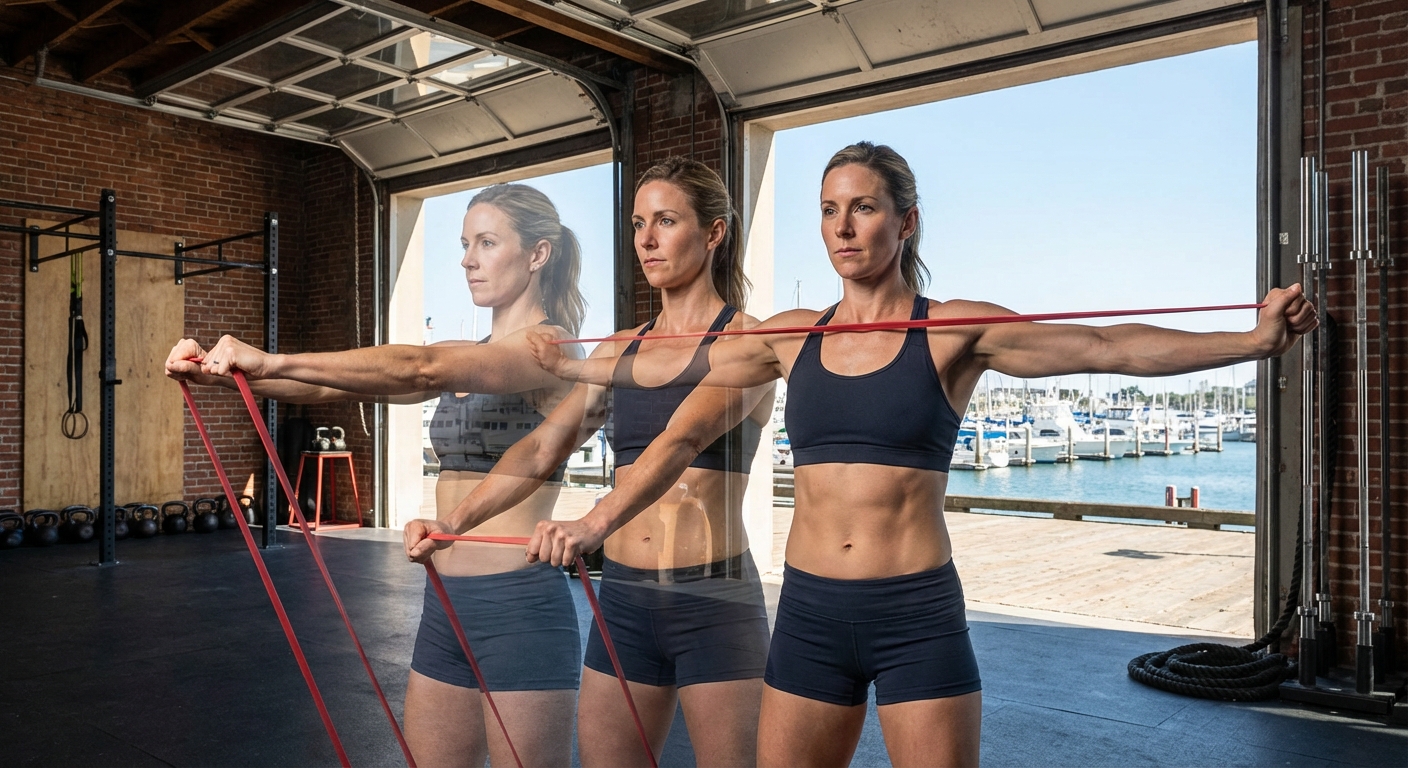
Posterior Deltoid & Scapular Retractors
Biomechanics Analysis
Kinematics & Pivots
The exercise operates within an Open Kinetic Chain. The distal segment (hand) moves freely while the proximal segment (torso) remains stationary.
- ▸ Primary Pivot: Glenohumeral joint undergoing horizontal abduction (θ ≈ 90°).
- ▸ Secondary Motion: Scapulothoracic retraction (adduction) gliding over the ribcage.
- ▸ Fixed Lever: The elbow remains locked in near-full extension (170°–180°), maximizing the moment arm.
Force Vectors & Torque
Resistance is variable (Hooke’s Law: F = kx). As the band stretches (x increases), force (F) increases, matching the muscle's shortened contractile range.
Torque Equation: τ = F × d
Because the lever arm (d) is the full length of the arm (shoulder to hand), even light resistance generates significant torque (τ) at the rear deltoid.
Stabilization Requirements
While the movement occurs at the shoulder, the core (rectus abdominis, obliques) acts as an anti-extension stabilizer. It must generate sufficient intra-abdominal pressure to prevent the lumbar spine from extending (rib flare) as the arms move posteriorly. Simultaneously, deep cervical flexors must maintain a neutral neck position against the tendency of the upper trapezius to shrug.
Muscle Activation Map
Prime Movers (Agonists)
- • Posterior Deltoid
- • Infraspinatus
- • Teres Minor
Synergists
- • Rhomboids (Major & Minor)
- • Middle Trapezius
- • Lower Trapezius
Stabilizers
- • Rectus Abdominis
- • External Obliques
- • Gluteus Maximus
- • Deep Cervical Flexors
Step-by-Step Execution
The Setup
Stand with feet shoulder-width apart, knees slightly unlocked. Grasp a resistance band with an overhand (pronated) grip, hands slightly wider than shoulder-width. Raise arms until they are parallel to the floor.
Engage the Brace
Exhale slightly to bring the ribs down towards the pelvis. Squeeze the glutes. This neutralizes the spine and ensures the movement comes strictly from the shoulders.
The Pull
Initiate the movement by driving the hands laterally apart. Imagine trying to touch the walls on either side of you. Keep the elbows straight but not hyperextended.
Peak Contraction
As the band touches your chest, aggressively squeeze your shoulder blades together (retraction). Hold this peak contraction for 1–2 seconds. Ensure your shoulders do not shrug up toward your ears.
Eccentric Return
Control the band as you return to the starting position. Do not let the band snap back. Maintain tension on the band even at the starting position; do not let it go slack.
Common Mistakes
| The Mistake | The Correction |
|---|---|
| Rib Flaring | This indicates lumbar extension compensation. Brace your abs and keep your ribcage tucked down. |
| Shrugging (Upper Trap Dominance) | Elevating the shoulders shifts focus to the upper traps. Consciously depress your scapulae (pull shoulders down) before starting. |
| Bending the Elbows | This turns the movement into a tricep extension and reduces the lever arm. Keep arms straight to isolate the rear delts. |
| Slack in the Band | Losing tension at the start reduces time under tension. Keep the band taut even in the starting position. |