Band Push Up
Accommodating Resistance • Horizontal Push • CKC
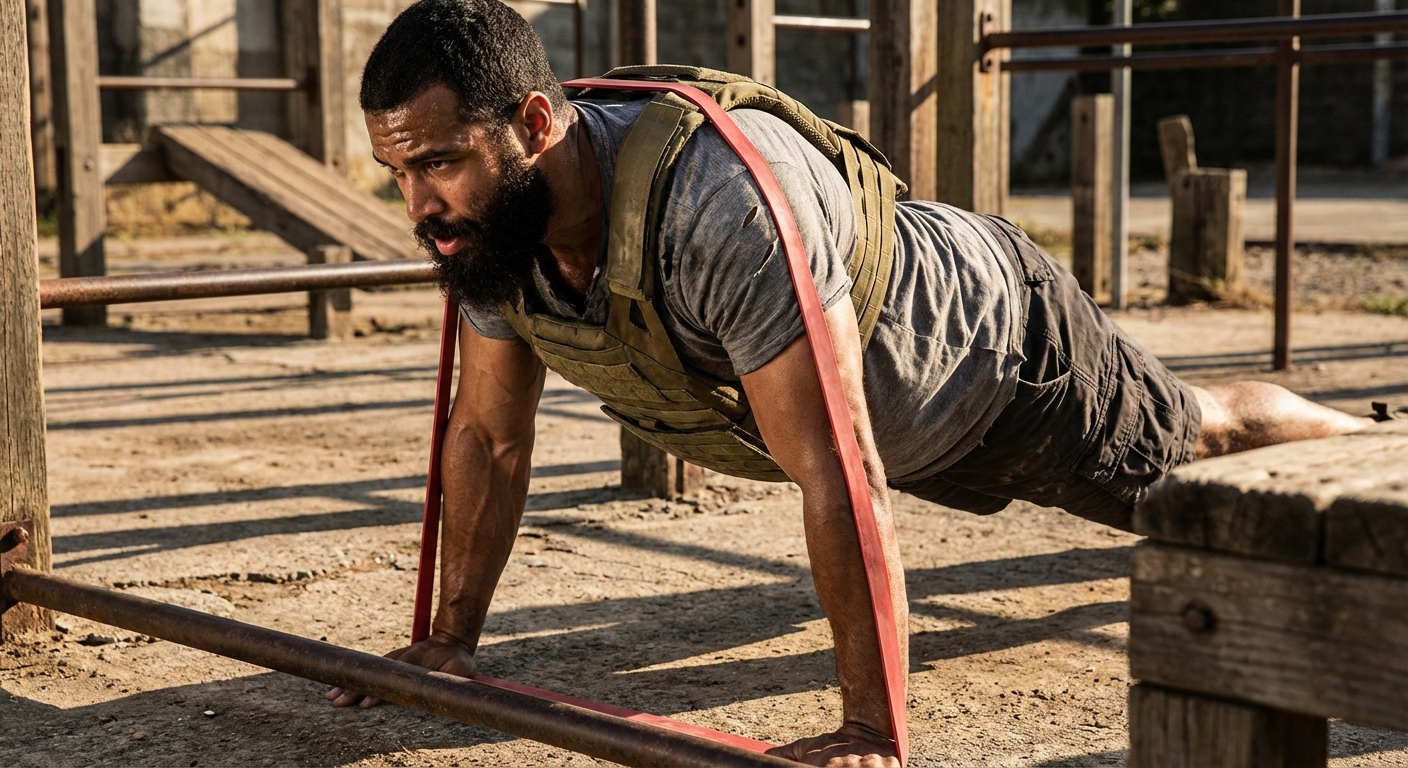
Biomechanics Deep Dive
Accommodating Resistance & Torque
The Band Push Up modifies the standard strength curve of a push-up through accommodating resistance. In a standard push-up, mechanical advantage increases as you extend the elbows (making the lockout easier). However, the band follows Hooke’s Law ($F = kx$), where resistance increases linearly with elongation.
This inversion provides peak tension at full elbow extension—the exact point where the skeletal lever arms typically reduce muscle demand. This forces the triceps and pectorals to produce maximal force throughout the entire Range of Motion (ROM), specifically maximizing torque (τ) at the humeroulnar joint during the final 30° of extension.
Kinetic Chain & Force Vectors
Chain Type: Closed Kinetic Chain (CKC). The distal segment (hands) is fixed, promoting greater joint approximation and rotator cuff activation compared to open chain pressing.
Force Vectors:
1. Gravity Vector: Vertical, acting on body mass center.
2. Elastic Vector: Compressive force acting dorsally on the thoracic spine and scapulae.
This creates a unique "anti-extension" moment arm on the lumbar spine. The core must generate significant isometric torque to prevent the hips from sagging under the combined load of gravity and band tension.
Muscle Activation Map
Primary Movers
- Pectoralis Major (Sternal & Clavicular)
- Triceps Brachii
- Anterior Deltoid
Secondary Support
- Serratus Anterior (Scapular Protraction)
- Coracobrachialis
- Anconeus
Stabilizers
- Rectus Abdominis (Anti-Extension)
- Gluteus Maximus
- Quadriceps
- Rotator Cuff
Execution Protocol
Band Setup
Kneel on the floor. Loop the resistance band behind your back, running it across your scapulae (shoulder blades) and under your armpits. Place your thumbs inside the loop ends to secure the band against your palms.
The Plank Lock
Assume a high plank position. Hands slightly wider than shoulder-width, fingers splayed for grip. Drive toes into the floor. Squeeze glutes and brace abdominals to neutralize the lumbar spine against the band's downward pressure.
Eccentric Descent
Lower your body under control, keeping the elbows tucked at approximately a 45° angle relative to the torso. Maintain a rigid spinal column—do not let the hips drop faster than the chest. Descend until the chest is just above the floor.
Concentric Explosion
Drive your palms through the floor. As you extend, the resistance will increase. Accelerate through this resistance. At the top, fully extend the elbows and protract the shoulder blades (push floor away) to fully engage the serratus anterior.
Common Faults & Corrections
| Fault | Biomechanical Consequence | Correction |
|---|---|---|
| Lumbar Sag (Hyperextension) | Shear force on lumbar vertebrae; loss of core integration. Band amplifies gravity here. | Posterior pelvic tilt; squeeze glutes aggressively. |
| T-Shape Elbow Flare | Shoulder impingement risk; reduced tricep mechanical advantage. | Tuck elbows to 45° ("Arrow" shape, not "T"). |
| Soft Lockout | Failure to utilize the accommodating resistance (peak tension). | Drive through the palms until elbows are fully extended. |
| Cervical Protraction (Head Bob) | Creates false perception of depth; strains cervical spine. | Keep chin tucked; eyes focused 6 inches in front of hands. |