Band Squat
A foundational closed-chain movement utilizing Reactive Neuromuscular Training (RNT) to optimize hip stability and gluteal engagement.
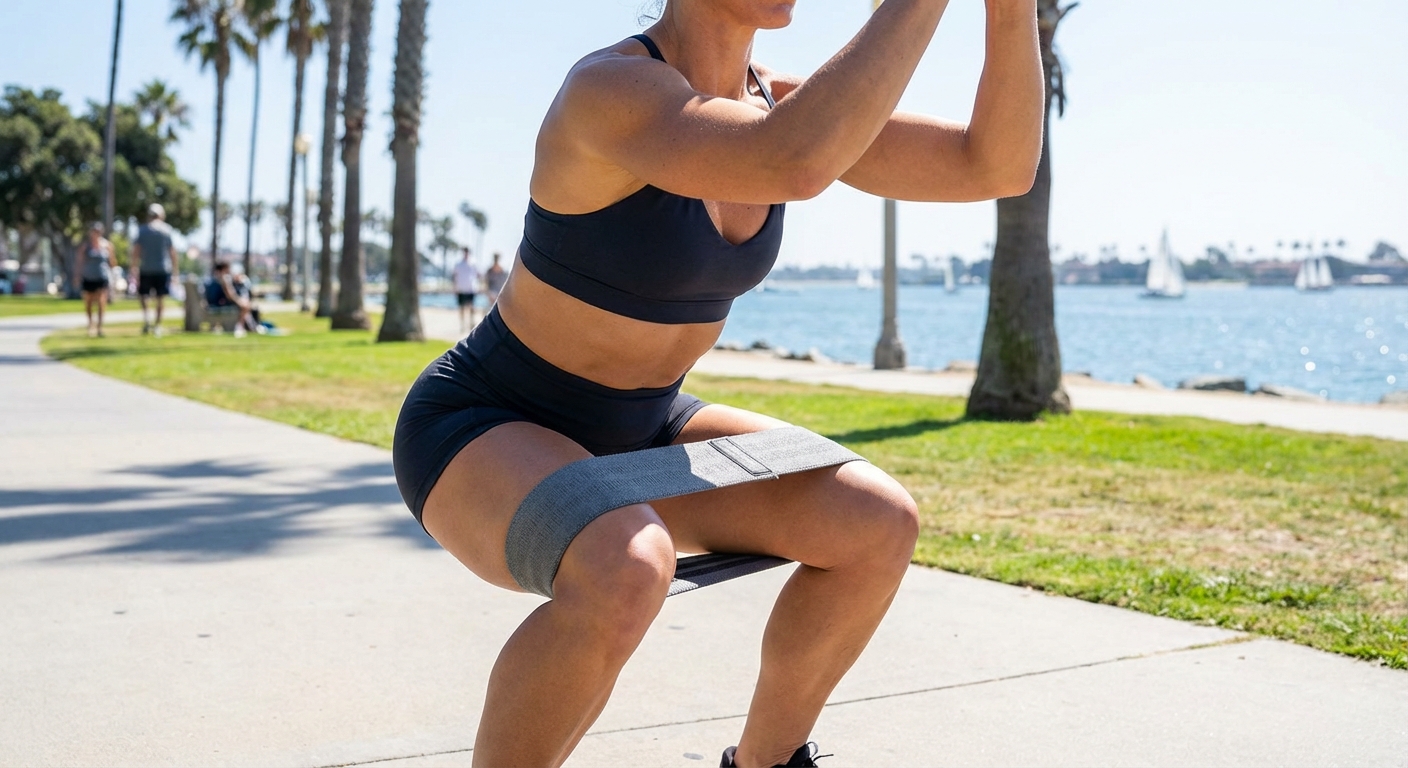
Biomechanics Deep Dive
⛓️ Kinetic Chain
This is a closed kinetic chain movement utilizing simultaneous hip flexion, knee flexion, and ankle dorsiflexion. While the primary force vector is vertical (gravity acting on body mass), the elastic band introduces a critical horizontal force vector (adduction moment). This requires constant hip abduction to maintain femoral alignment.
⚙️ Pivot Points
Primary rotation occurs at the acetabulofemoral (hip) and tibiofemoral (knee) joints, with stabilizing rotation at the talocrural (ankle) joint. The moment arm for the hips increases significantly as depth is achieved (θ ≈ 100° flexion), maximizing torque demand on the posterior chain.
⚖️ Stabilization
There is a high demand for isometric hip abduction to counteract the band's tension (τ = r × F). Intra-abdominal pressure (IAP) stabilizes the lumbar spine against shear forces. The 'tripod foot' (calcaneus, 1st, and 5th metatarsal heads) is essential to prevent ankle pronation under load.
Physiological Activation
Primary Movers (Agonists)
Quadriceps Femoris: The vastus lateralis, vastus medialis, vastus intermedius, and rectus femoris are the primary extensors of the knee.
Gluteus Maximus: The primary extensor of the hip, responsible for the drive out of the bottom position (the "hole").
Key Reactive Muscles
Gluteus Medius & Minimus: The defining feature of the band squat. These muscles must fire isometrically to abduct the femur against the band's resistance, preventing knee valgus (knees collapsing inward). This is often referred to as "turning on" the hips.
Synergists
- Adductor Magnus (Hip Extension role)
- Soleus (Ankle Stability)
Stabilizers
- Erector Spinae
- Transverse Abdominis
- Multifidus
Execution Strategy
Preparation
Place a mini-loop resistance band around your legs, positioning it just above the knees (never directly on the joint). Assume a stance roughly shoulder-width apart, with toes slightly externally rotated (5°–15°).
Rooting & Tension
Establish the 'tripod foot' by gripping the floor with your big toe, little toe, and heel. Actively push your knees outward against the band to engage the lateral glutes. Brace your core by breathing deeply into your diaphragm (IAP).
The Descent
Initiate the movement by breaking at the hips and knees simultaneously. Sit the hips back and down while keeping the chest proud. Throughout the descent, fight the band's pull—do not let your knees track inside your toes.
The Drive
Once you reach depth (thighs parallel to the floor or lower), reverse the motion by driving vertically. Focus on "spreading the floor" with your feet to maintain glute tension. Exhale forcefully as you return to the standing position, fully extending the hips.
Error Correction Protocol
| Deviation | Biomechanical Cause | Corrective Cue |
|---|---|---|
| Knee Valgus (Collapse) | Failure of Gluteus Medius to counteract adduction moment. | "Rip the floor apart with your feet." |
| Lumbar Flexion (Rounding) | Lack of core stiffness or mobility restrictions in hips/ankles. | "Keep your chest proud and brace your stomach." |
| Anterior Weight Shift | Center of Mass drifting forward of the mid-foot. | "Keep your heels glued to the ground." |
| Insufficient Depth | Reduced Moment Arm at the hip; decreased posterior chain activation. | "Sit down until your hip crease is below your knee." |