Child's Pose to Upward Dog
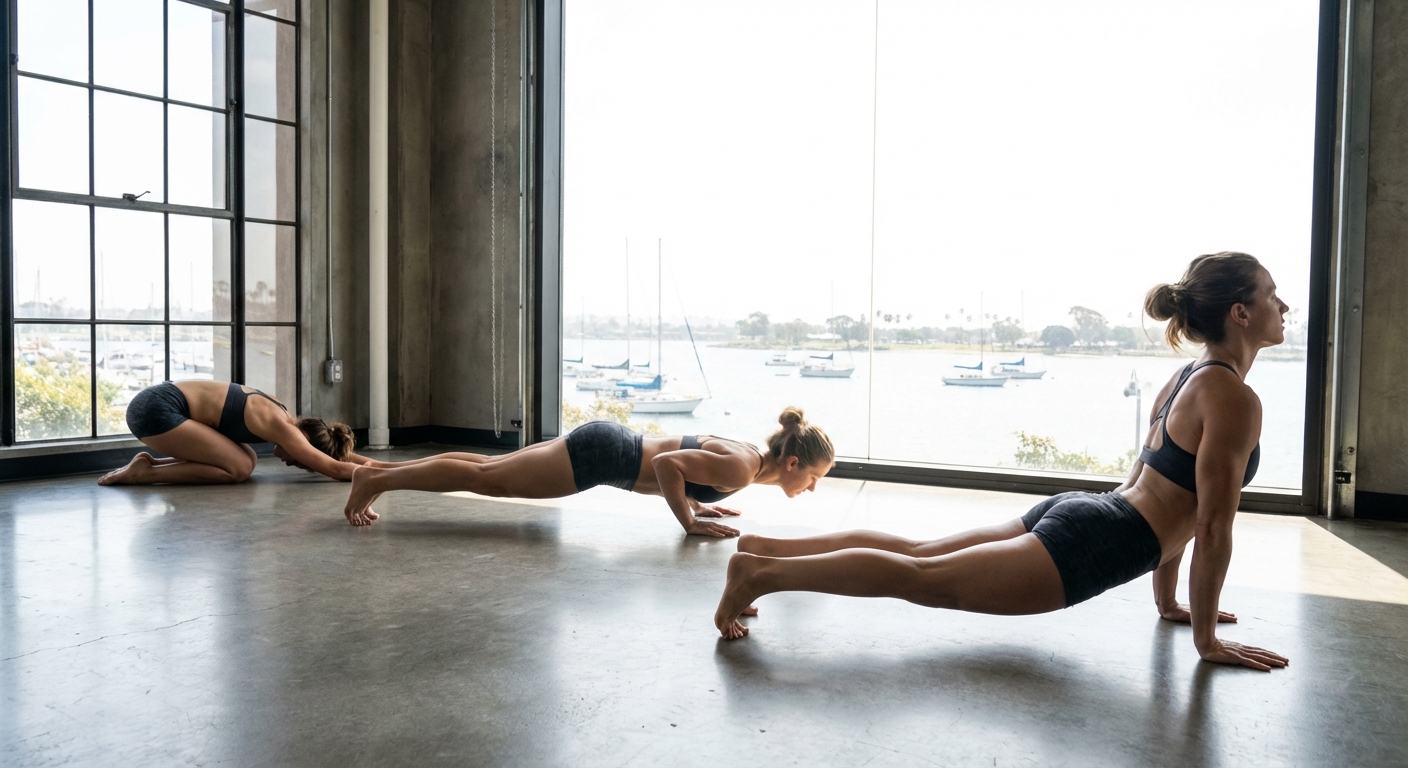
A closed kinetic chain spinal wave transitioning from deep lumbar flexion to full extension.
Biomechanics Analysis
Kinetic Chain Dynamics
The movement is a closed kinetic chain spinal wave. It begins in deep lumbar flexion (Child's Pose) and transitions fluidly to full spinal extension (Upward Dog).
Force transfers from the hips through the spine as the center of mass shifts anteriorly. This requires a 'swooping' translation where the chest glides low to the ground—maximizing the moment arm at the shoulder momentarily—before the extensors fire to lift the torso.
Pivots & Anchors
Primary pivots occur at the acetabulofemoral (hip) joint and the glenohumeral (shoulder) joint. The movement requires synchronization between hip extension and shoulder flexion/extension cycles.
The wrists serve as a fixed anchor point. As the shoulders travel slightly past the wrists in the terminal phase, significant dorsiflexion range of motion (often > 90°) is required to maintain the stack.
Stabilization Requirements
Scapular Control
There is a high demand on the scapular depressors (lower trapezius, serratus anterior) to prevent shoulder elevation. Without this, the upper traps compensate, causing "shrugging" which compresses the cervical spine.
Lumbar Protection
The Transversus Abdominis must maintain tension throughout the transition. As the hips drop and the spine extends, intra-abdominal pressure protects the lumbar vertebrae from excessive shearing and compression forces ($F_c$).
Muscle Activation Map
Primary Movers
-
Erector Spinae Driving spinal extension.
-
Triceps Brachii Elbow extension to lift torso.
-
Pectoralis Major Eccentric control during the "swoop".
Stabilizers
-
Serratus Anterior Scapular depression & stability.
-
Rotator Cuff Glenohumeral dynamic stability.
-
Wrist Flexors Ground interaction & anchor.
Secondary Support
-
Gluteus Maximus Hip extension assistance.
-
Hamstrings Eccentric control of hip flexion.
Step-by-Step Execution
-
1
The Setup (Child's Pose)
Begin in Balasana with hips resting on heels and arms extended fully forward. Plant palms firmly into the mat, spreading fingers wide to create a stable base. Engage lats by wrapping outer armpits toward the floor.
-
2
The Low Swoop
Bend elbows and lower your chest toward the mat. Imagine sliding your nose along the ground like a marble is rolling under it. Keep elbows hugged tight to your ribcage (reducing shear force on the shoulder).
-
3
The Transition
As your head passes your hands, begin to transfer weight forward. The hips will lift off the heels and lower toward the mat. Simultaneously, press through the palms to begin extending the elbows.
-
4
Terminal Extension (Upward Dog)
Straighten arms fully. Draw shoulders down and back, effectively "pulling" your chest through your arms. Engage glutes slightly to protect the lower back. Knees should hover off the mat, weight supported by tops of feet and hands.
Common Mistakes & Corrections
| Fault | Biomechanical Consequence | Correction |
|---|---|---|
| Shoulder Elevation (Shrugging) | Transfers load to Upper Trapezius and Levator Scapulae; creates cervical compression. | Depress scapulae actively. Visualize increasing the distance between earlobes and shoulders. |
| Lumbar Hinge (Dumping) | Excessive compression forces on lumbar vertebrae L4-L5 due to lack of anterior core tension. | Engage Transversus Abdominis and glutes before hips reach the floor. |
| Elbow Flaring | Internal rotation of the humerus, increasing impingement risk at the subacromial space. | Create external rotation torque. Keep "elbow pits" facing forward and elbows grazing ribs. |