Child's Pose
The fundamental pose for spinal elongation, hip flexion mobility, and parasympathetic nervous system activation.
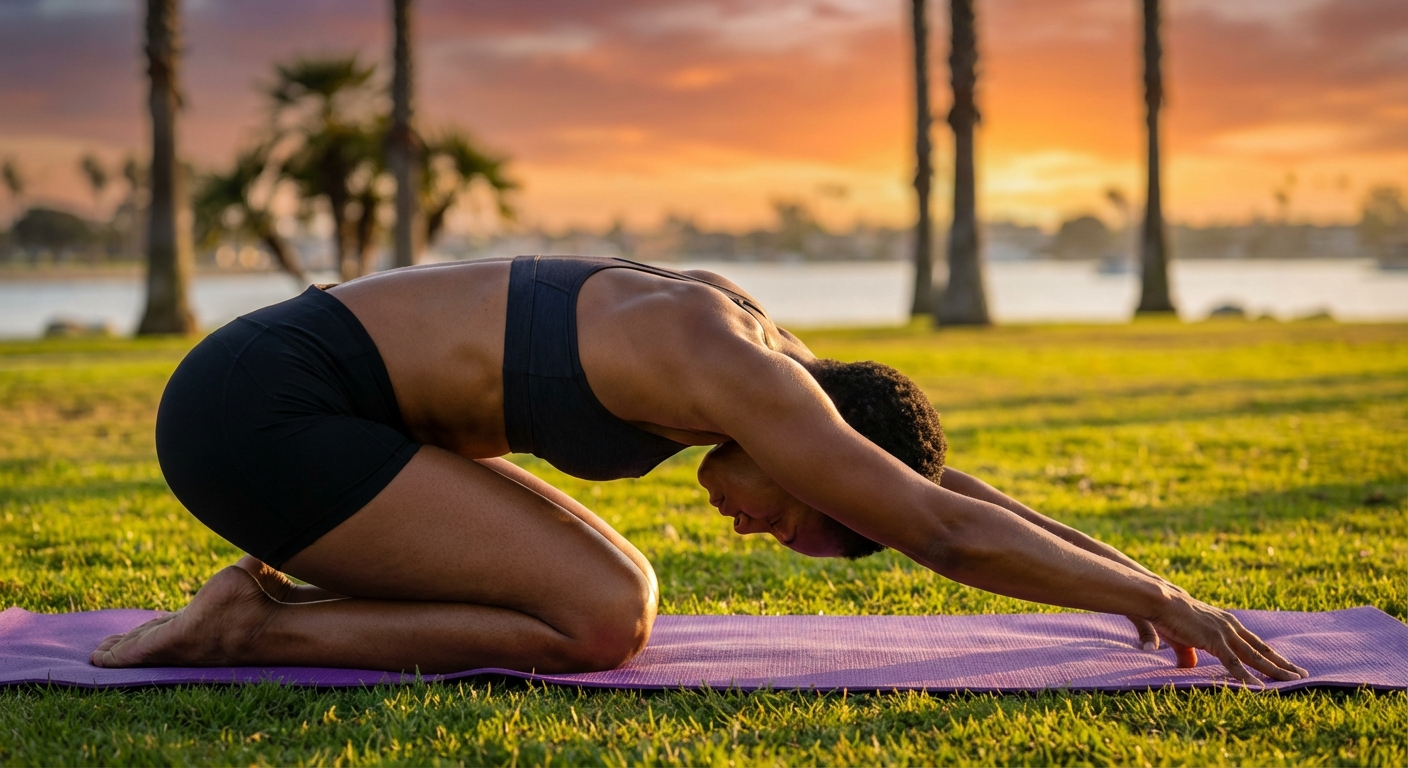
Biomechanics Analysis
Kinetic Chain
Anchored hands transmit tension through the latissimus dorsi and thoracolumbar fascia directly to the deeply flexed hip pivot. This creates a traction force ($\vec{F}_{traction}$) along the spinal column, decompressing intervertebral discs.
Joint Mechanics
Primary rotation occurs at the Acetabulofemoral joint (requiring 120°+ flexion). Secondary passive compression occurs at the Tibiofemoral joint. The Glenohumeral joint undergoes active flexion to facilitate thoracic extension.
Stabilization
Serratus anterior engagement is vital for scapular upward rotation, clearing space for the humerus. Deep abdominal support modulates spinal flexion, preventing excessive lumbar rounding if hip mobility is limited.
Muscle Recruitment Map
Lengthened (Target)
- Gluteus Maximus: Experiences deep passive lengthening at maximum hip flexion.
- Erector Spinae: The entire paraspinal group is gently stretched from sacrum to cranium.
- Latissimus Dorsi: Stretched via arm extension, linking the thoracolumbar fascia to the humerus.
Passive & Stabilizers
- Quadriceps & Tibialis Anterior: Passive stretch due to deep knee flexion and ankle plantar flexion.
- Diaphragm: Compressed anteriorly, forcing posterior expansion (back breathing) against the erectors.
Execution Protocol
-
1
Foundation Setup
Start in a tabletop position (hands and knees). Bring your big toes to touch, while separating your knees slightly wider than your hips.
-
2
Hip Descent
On an exhale, sink your hips back toward your heels. Prioritize the hips anchoring down rather than the head touching the floor.
-
3
Spinal Extension
Walk your hands forward as far as possible. Press the palms into the floor to actively engage the serratus anterior and create traction through the spine.
-
4
Grounding
Rest your forehead gently on the mat (or a block). Allow the chest to melt between the thighs.
-
5
Posterior Expansion
Breathe deeply into the back of your rib cage (Posterior Mediastinum). Feel the ribs expand laterally and posteriorly with every inhalation.
Common Analysis & Corrections
| Deviation | Biomechanical Consequence | Correction |
|---|---|---|
| Elevated Shoulders (Shrugging) | Compresses the cervical spine and engages Upper Trapezius instead of Lats. | Externally rotate shoulders ("wrap triceps down") and draw scapulae toward hips. |
| Hips Elevated High | Reduces flexion at the Acetabulofemoral joint; shifts weight excessively into hands. | Place a bolster or block between calves and hamstrings to support the pivot point. |
| Shallow "Chest" Breathing | Fails to utilize intra-abdominal pressure to massage the lumbar spine from the inside. | Focus on expanding the lower back ribs; visualize filling a balloon in your lower back. |