Diamond Push-Up
An advanced closed-kinetic chain variation emphasizing triceps brachii dominance through mechanical disadvantage and narrowed base of support.
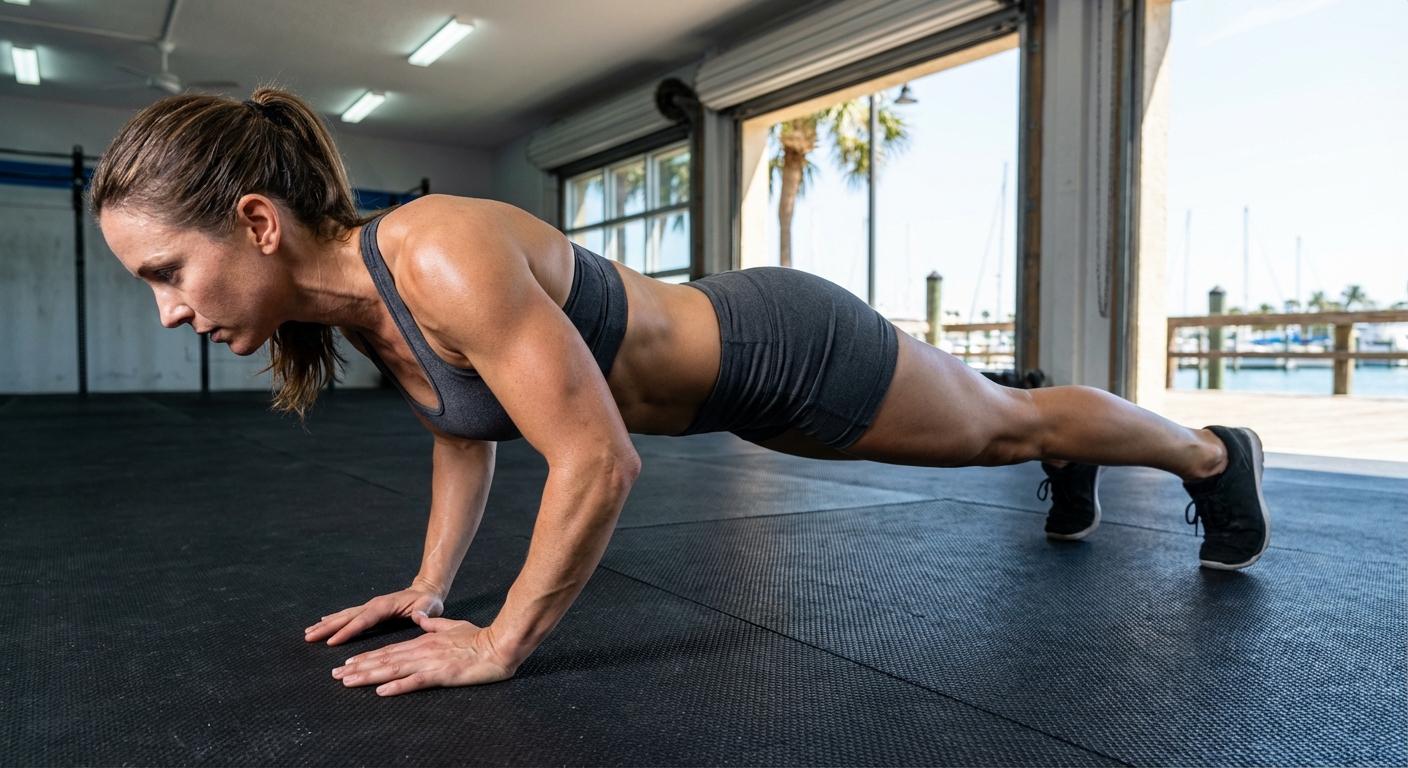
Biomechanics & Physics
Kinetic Chain Transmission
This is a closed kinetic chain movement. Force is transmitted from the metacarpophalangeal joints, traveling vertically through the radius and ulna, directly into the humerus. Unlike standard push-ups, the narrowed base shifts the drive heavily onto triceps extension (elbow joint) while pectoralis and deltoid flexion play a secondary, albeit crucial, role in humerus adduction.
Levers & Pivot Points
The body operates as a Class 2 lever system. The primary fulcrum is located at the toes (metatarsals). The load (body mass) is situated between the fulcrum and the effort force (hands). The glenohumeral (shoulder) joint acts as the upper body axis, while the humeroulnar (elbow) joint bears an acute load due to the increased flexion angle required at the bottom of the movement.
Torque & Moment Arms
By narrowing the hand placement ($d \approx 0$ between hands), we increase the effective range of motion for the elbow. The moment arm for the triceps is maximized relative to the pectorals. The equation for torque ($\tau = r × F$) implies that while the total load remains constant, the mechanical disadvantage placed on the triceps requires significantly higher motor unit recruitment to extend the elbow against gravity.
Stabilization Requirements
Due to the narrowed base of support, rotational stability is compromised compared to wide push-ups. The Rectus Abdominis must fire isometrically to prevent lumbar hyperextension (sagging). The Gluteus Maximus must maintain posterior pelvic tilt. Crucially, the Serratus Anterior is active to prevent scapular winging at the top of the concentric phase.
Muscular Activation
Prime Movers (Agonists)
- Triceps Brachii Target (Lateral/Medial Heads)
- Pectoralis Major Sternal/Clavicular
- Anterior Deltoid Synergist
Stabilizers (Isometric)
- Rectus Abdominis Anti-Extension
- Serratus Anterior Scapular Protraction
- Gluteus Maximus Pelvic Control
Execution Protocol
-
1
The Setup
Assume a high plank position. Place hands directly under the sternum so that index fingers and thumbs touch, forming a "diamond" or triangle shape. Spread fingers wide to distribute load across metacarpals.
-
2
Systemic Tension
Engage the core to neutralize the lumbar spine. Squeeze glutes and quads. The body should form a rigid, straight line from vertex to heels. Externally rotate shoulders slightly to pack the lats.
-
3
Eccentric Phase (Descent)
Lower the chest towards the hands in a controlled manner (2-3 seconds). Keep elbows tucked close to the ribcage (approx 30° to 45° abduction). Do not let elbows flare out to 90°. Descend until the sternum nearly touches the dorsal side of your hands.
-
4
Concentric Phase (Ascent)
Drive palm heels into the floor. Forcefully extend the elbows while maintaining chest depression. Exhale during the press. Lock out the elbows at the top to achieve peak triceps contraction.
Deviation Analysis
| Error | Biomechanical Consequence | Correction |
|---|---|---|
| Elbow Flare (>60°) | Increases shear force on the glenohumeral joint; reduces triceps load. | Tuck elbows towards ribs; screw hands into floor. |
| Lumbar Hyperextension | Disconnects kinetic chain; places compressive load on lumbar vertebrae. | Posterior pelvic tilt; brace abs as if taking a punch. |
| Cervical Protraction | "Chicken necking" creates false perception of depth; strains cervical spine. | Keep chin tucked; eyes fixed on floor slightly ahead of hands. |
| Incomplete ROM | Fails to engage triceps at peak elongation; reduces hypertrophy stimulus. | Chest to hands contact on every repetition. |