Dumbbell Split Squat
The foundational unilateral pattern for correcting asymmetries, building glute stability, and enhancing lower body hypertrophy.
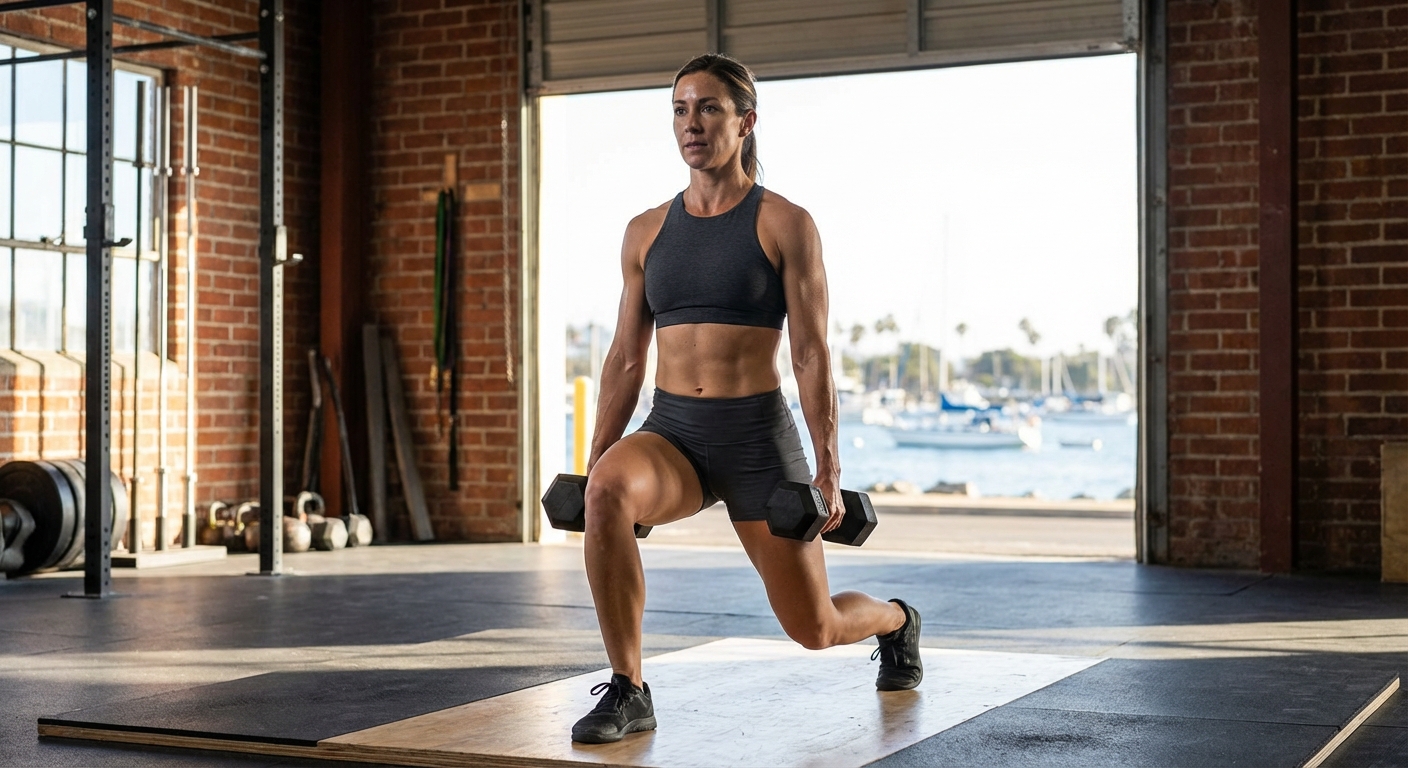
Biomechanics Analysis
Kinetic Chain Dynamics
The split squat functions as a Unilateral Closed Kinetic Chain (CKC) movement. Unlike a lunge, the feet remain fixed, significantly altering the stabilization demands. The primary force vector (F_lead) dictates that approximately 80% of the load should be driven through the lead limb, utilizing the trail leg primarily for balance rather than force production.
Pivot Points & Angles
The movement relies on three distinct pivots. The Lead Knee moves into flexion, ideally reaching θ_knee ≈ 90° at the bottom of the eccentric phase. The Lead Hip angle (θ_hip) is variable; a vertical torso emphasizes the knee extensor moment arm (quadriceps), while a forward lean increases the hip extensor moment arm (glutes). The Trail MTP joint acts as the rear anchor, requiring significant extension mobility.
Stabilization Mechanics
- ➤ Gluteus Medius: Critical for resisting valgus torque (τ). Without active firing, the lead knee will collapse inward, compromising the ACL and MCL.
- ➤ Core Rigidty: The core must resist rotational forces and lateral flexion in the Frontal and Transverse planes, owing to the narrow base of support.
- ➤ Force Vector: Vertical Ground Reaction Force (GRF) is maximized when the lead shin remains relatively vertical or slightly translated forward, ensuring optimal load transfer through the mid-foot.
Muscle Recruitment Map
Primary Movers
Agonists- Quadriceps Femoris
- Gluteus Maximus
Secondary
Synergists- Adductor Magnus
- Hamstrings (Eccentric)
Stabilizers
Fixators- Gluteus Medius
- Transverse Abdominis
- Gastrocnemius
Execution: Step-by-Step
The Setup
Stand holding dumbbells at your sides (neutral grip). Take a split stance. Ensure your feet are hip-width apart, not on a single tightrope line. This width is crucial for the frontal plane stability required by the core.
The Descent (Eccentric)
Lower your hips vertically toward the floor. Maintain approximately 80% of your weight on the front heel. The back knee should travel straight down, stopping just before touching the ground. Inhale deeply into the diaphragm to brace the spine.
The Bottom & Drive (Concentric)
At the bottom, your front knee should be at roughly 90° flexion. Drive forcefully through the front mid-foot to return to the starting position. Exhale as you ascend. Keep the torso angle constant—do not let the hips shoot up first.
Correction Table
| Common Error | The Fix |
|---|---|
| Tightrope Walking | Widen the stance laterally. Feet should be on "train tracks," not a single line. |
| Trail Leg Dominance | Shift torso slightly forward. Focus mind-muscle connection on the front glute. |
| Knee Valgus (Cave In) | Cue "drive the knee out" towards the pinky toe. Reduce weight if necessary. |
| Lumbar Hyperextension | "Ribs down." Brace the abs as if about to be punched before descending. |
"Stability dictates force production. Master the split squat, and your bilateral squat will skyrocket."