Biomechanics Deep Dive
Kinetic Chain Dynamics
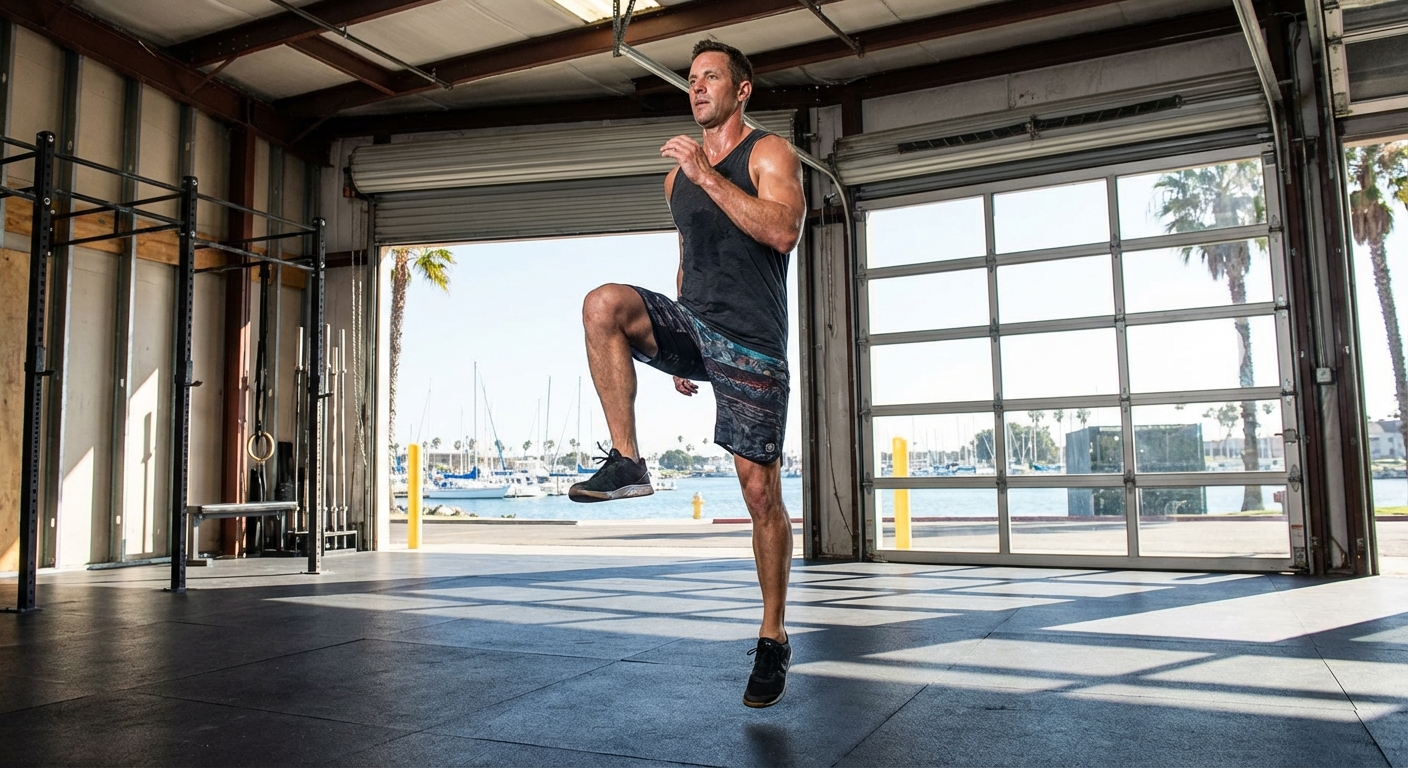
The movement creates a dual-state mechanic: the stance leg operates as a closed kinetic chain while the drive leg is an open kinetic chain. Ground reaction force travels through the metatarsals into the triceps surae and quadriceps of the stance leg for vertical propulsion. Simultaneously, the contralateral hip flexors explosively recruit to drive the swing leg into flexion.
Joint Pivots & Torque
Primary pivots occur at the acetabulofemoral (hip) joint, demanding >90° flexion. The talocrural (ankle) joint is critical, requiring a rapid cycle from dorsiflexion (swing leg preparation) to forceful plantarflexion (stance leg propulsion) to minimize ground contact time. The shoulder joint provides reciprocal torque to counterbalance pelvic rotation.
LPHC Stabilization
High-level engagement of the Lumbopelvic Hip Complex (LPHC) is mandatory to dissociate hip flexion from lumbar extension. The rectus abdominis acts as an "anti-extension brake," preventing the torso from leaning back as the heavy leg lever is lifted. The gluteus medius fires isometrically to maintain pelvic neutrality in the frontal plane.
Anatomy & Recruitment
High knees are not just a cardio drill; they are a maximal intent power exercise for the hip flexors and a stiffness drill for the lower limb complex.
Primary Movers (Agonists)
Stabilizers
Hip Flexion Demand
Ground Contact Time: < 150ms
Step-by-Step Execution
The Setup (Stance)
Stand tall with feet hip-width apart. Engage the core to neutralize the pelvic tilt (avoid anterior tilt). Maintain a neutral cervical spine by looking straight ahead.
The Drive Phase
Explosively drive one knee upward toward the chest. The goal is to break the 90-degree plane at the hip. As the knee rises, actively dorsiflex the ankle (toes up) to prepare for ground contact.
Contralateral Arm Swing
Coordinate the opposite arm with the driving leg. Drive the elbow back aggressively while the hand swings up to cheek height ("Cheek to Hip"). This arm action counterbalances the rotational torque generated by the legs.
Ground Contact & Rhythm
Land on the ball of the foot (metatarsals), not the heel. The contact should be light, bouncy, and brief. Immediately transition into the next repetition. Focus on frequency and knee height over forward distance.
Common Faults & Analysis
| The Mistake | Biomechanical Consequence | The Fix |
|---|---|---|
| Leaning Backward | Compensatory lumbar hyperextension due to weak core or tight hips. Reduces hip flexion efficiency. | Engage anterior core (ribs down). Think "nose over toes" slightly. |
| Heel Striking | Increases ground contact time and braking forces. Transfers shock up the chain to the knee/hip. | Stay on the metatarsals (balls of feet). Keep the ankle "stiff" and reactive. |
| Low Knee Drive | Fails to train the acetabulofemoral flexion range. Reduces the plyometric stimulus for the hip flexors. | Place hands at hip height and aim to hit palms with knees on every rep. |
| Passive Arms | Creates rotational instability in the torso (Transverse Plane), wasting energy. | Aggressively drive elbows back. Arm speed dictates leg speed. |