Inverted Row
The gold standard for horizontal pulling mechanics, integrating core stability with upper back hypertrophy.
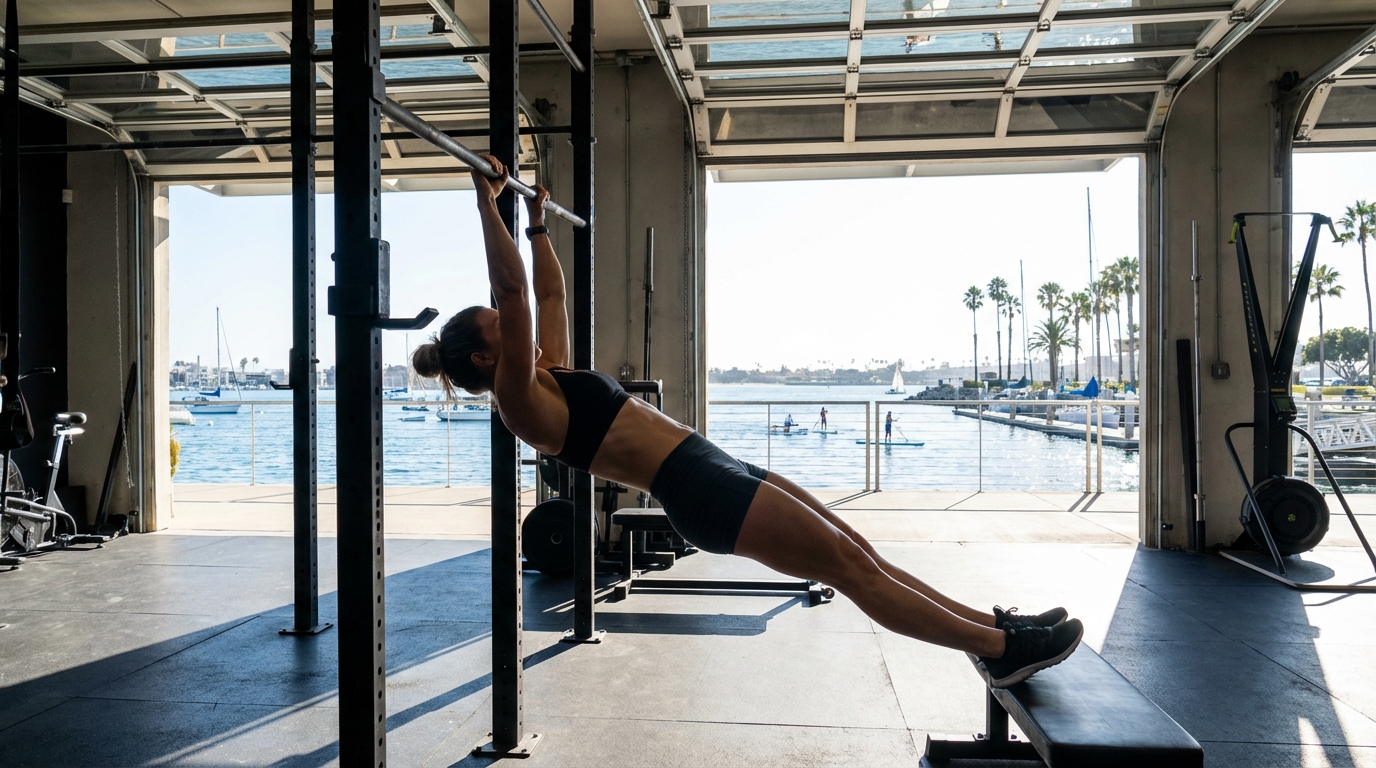
Visual Guide
Biomechanical Analysis
The Lever System
The Inverted Row functions as a Class 2 Lever System within a Closed Kinetic Chain (CKC).
- Fulcrum (F): The talocrural joint (ankles), acting as the static pivot point.
- Load (L): The body's Center of Mass (CoM), distributed along the torso and hips.
- Effort (E): Generated by the upper extremities at the glenohumeral joint.
Because the Load is situated between the Fulcrum and the Effort, the mechanical advantage is generally > 1, allowing for controlled muscular loading.
Force Vectors & Stabilization
Chain Dynamics: Unlike open-chain rowing, the distal segment (hands) is fixed. This necessitates high-threshold isometric contraction of the core to prevent energy leaks.
Grip Mechanics: Utilizing a supinated (underhand) grip places the distal tendon of the biceps brachii in a linear orientation, maximizing recruitment alongside the latissimus dorsi.
Muscular Activation Profile
Primary Movers
- Latissimus Dorsi
- Trapezius (Middle/Lower)
- Rhomboids
Secondary Movers
- Biceps Brachii
- Posterior Deltoid
- Brachialis
Stabilizers
- Rectus Abdominis
- Gluteus Maximus
- Erector Spinae
Execution Protocol
The Setup
Set a barbell in a rack (or use rings) at roughly waist height. Lie underneath the bar so that it aligns directly over your lower chest. Grasp the bar with a supinated (underhand) grip, hands shoulder-width apart.
Rigid Body Alignment
Extend your legs fully, digging your heels into the floor. Contract your glutes and abs forcefully to lift your hips off the ground. Your body should form a perfectly straight line from ankles to head.
The Concentric Phase
Initiate the movement by retracting the scapulae (squeezing shoulder blades together). Drive your elbows down and back, pulling your chest up to touch the bar. Maintain a packed neck position—do not jut your chin forward.
The Eccentric Phase
Lower yourself under control, resisting gravity. Allow the scapulae to protract (spread apart) slightly at the bottom to achieve a full stretch on the lats and rhomboids, but keep the core tight to prevent lumbar hyperextension.
Common Mistakes & Corrections
| Error | Biomechanical Consequence | Correction |
|---|---|---|
| Sagging Hips | Breaks the lever arm; reduces core activation and shifts load inappropriately to the shoulders. | Squeeze glutes maximally. Think "plank position" throughout the rep. |
| Anterior Humeral Glide | Shoulder rolls forward at the top, impinging the rotator cuff tendons. | Focus on "chest to bar," not just chin to bar. Retract scapulae first. |
| Chin Jutting | Cervical spine extension creating false perception of ROM completion. | Keep the chin tucked (double chin cue). Maintain neutral cervical alignment. |
| Wrist Flexion | Curling wrists shortens the lever prematurely and overloads forearm flexors. | Keep wrists neutral/straight. Visualize the hands as hooks. |