Inverted Row
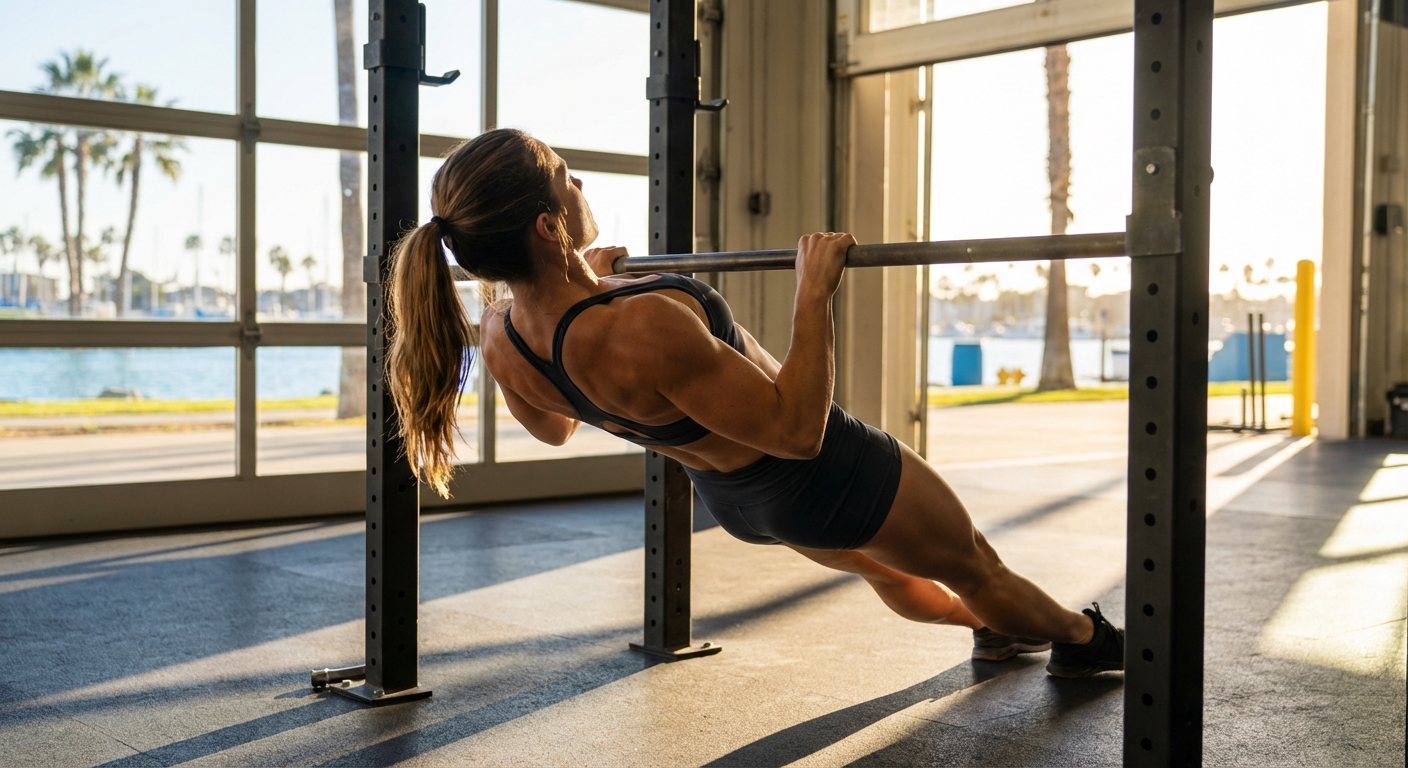
The premier bodyweight horizontal pulling exercise for developing upper back thickness and scapular stability within a rigid, closed kinetic chain environment.
Biomechanics Analysis
Clinical Deep Dive01. Kinetic Chain & Pivots
The Inverted Row operates as a Closed Kinetic Chain (CKC) movement. Unlike open-chain rows, the distal segment (hands) is fixed to the bar, allowing force transmission to reverse down the chain.
- Fulcrum: The Calcaneus (heel) acts as the ground-contact pivot point.
- Glenohumeral Joint: Primary rotation occurs here, with extension ranging from θ ≈ 0° (arms outstretched) to -60° (top of movement).
- Humeroulnar Joint: Flexion occurs from α ≈ 10° to 120°.
02. Force Vectors & Torque
The body functions as a rigid lever arm. The difficulty is dictated by the angle of the body relative to the gravity vector (g ↓).
Anatomy & Muscle Map
Prime Movers (Agonists)
Latissimus Dorsi
The primary shoulder extensor. It generates the majority of the force to pull the humerus closer to the midline.
Mid/Lower Trapezius & Rhomboids
Responsible for scapular retraction. These muscles must initiate the movement to ensure shoulder health and stability.
Posterior Deltoid
Assists in horizontal abduction and extension of the shoulder.
Key Stabilizers
- Rectus Abdominis Prevents rib flair and lumbar extension.
- Gluteus Maximus Maintains hip extension (prevents sagging).
- Biceps Brachii Acts as a synergist for elbow flexion.
Execution Protocol
Setup & Grip
Set a barbell in a rack at approximately waist height (lower is harder, higher is easier). Grip the bar slightly wider than shoulder-width using a pronated (overhand) grip. Position yourself under the bar so your chest is directly aligned with it.
Engage the Rigid Pillar
Before pulling, establish tension. Squeeze your glutes to extend the hips and brace your core firmly. Your body should form a straight line from heels to head. Retract your scapulae slightly to set the shoulders.
The Pull Phase
Initiate the movement by driving your elbows down and back. Pull your chest toward the bar. Do not let your hips sag or your head jut forward. The target is to touch the lower chest/sternum to the bar.
Top Contraction
At the top of the movement (humerus in extension), squeeze your shoulder blades together forcefully. Hold this peak contraction for 1 second to maximize motor unit recruitment in the Rhomboids and Middle Trapezius.
Eccentric Control
Lower yourself back to the starting position under control (approx. 2-3 seconds). Maintain the rigid plank position throughout the descent. Do not unlock the shoulders completely at the bottom; keep tension on the lats.
Common Mistakes & Corrections
| The Error | Biomechanical Consequence | The Fix |
|---|---|---|
| Sagging Hips | Broken kinetic chain; load shifts from back muscles to passive structures; failure of gluteal stabilization. | Squeeze glutes maximally before initiating the pull. Think "rigid plank." |
| Chin Jutting Forward | Cervical spine extension compensates for lack of thoracic extension; increases neck strain. | Pack the neck (make a double chin). Keep the gaze fixed on the ceiling, not the bar. |
| Shoulder Shrugging | Over-activation of Upper Trapezius; prevents proper depression and retraction of the scapula. | Drive shoulders down away from ears. Think about putting your shoulder blades into your back pockets. |
| Incomplete ROM | Reduces time under tension at peak contraction; limits rhomboid development. | Raise the bar height to decrease difficulty until you can touch your chest to the bar on every rep. |