Clinical Biomechanics
The Spring Mechanism
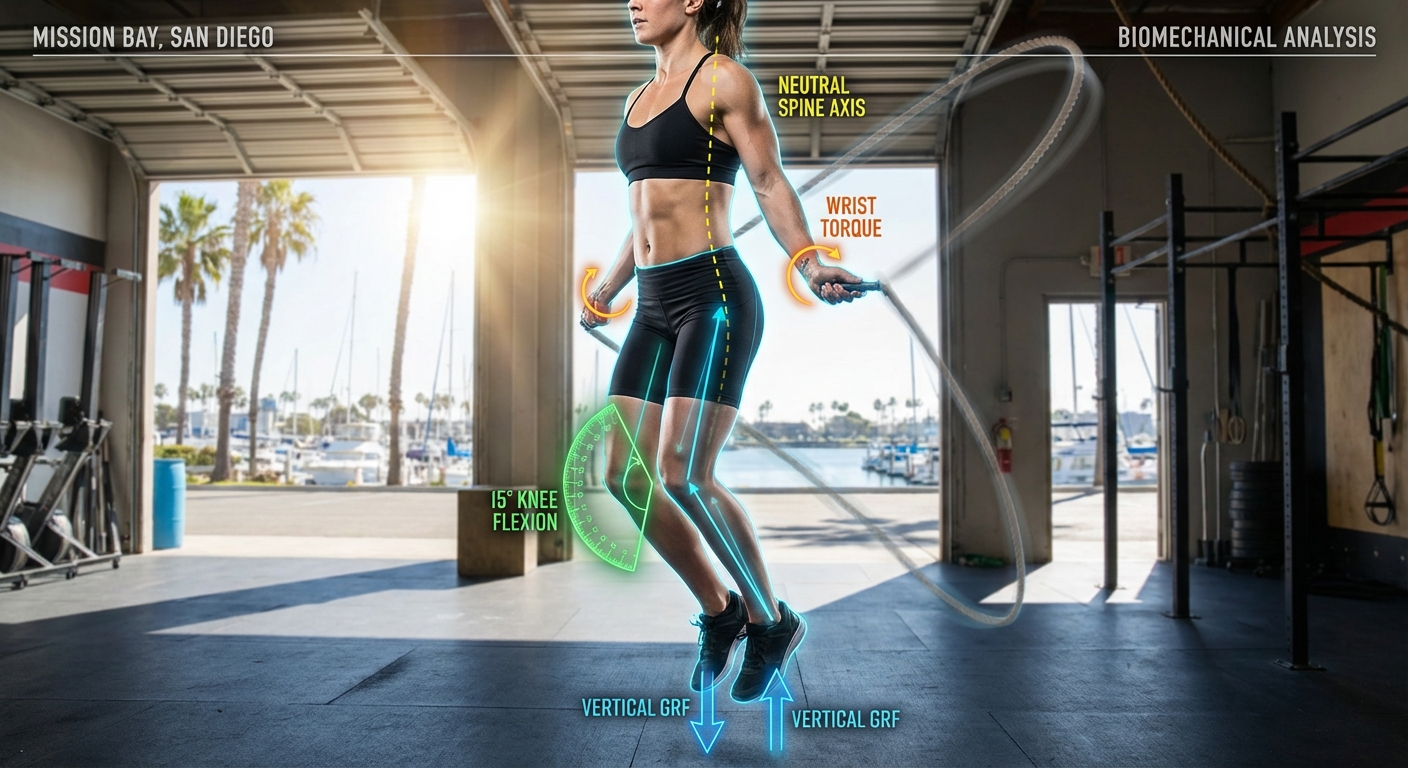
The movement relies heavily on the Stretch-Shortening Cycle (SSC) of the lower leg complex. The Gastrocnemius, Soleus, and Achilles Tendon act as a biological spring system. Efficiency is achieved by minimizing ground contact time and maximizing stiffness upon impact.
Rotational Torque
Primary rotational torque must be generated at the Radiocarpal (wrist) joints via circumduction, not the glenohumeral (shoulder) joints. The Talocrural (ankle) joint serves as the primary fulcrum for vertical displacement, minimizing knee flexion.
Axial Rigidity
The Transversus Abdominis and Erector Spinae act as an isometric clamp, maintaining a neutral spine to prevent energy leaks. Scapular retractors (Rhomboids) must keep the glenohumeral joint packed, locking the elbows at the costal margin (rib cage).
Muscle Map
Primary Movers (Agonists)
-
Gastrocnemius Provides explosive plantar flexion for the jump.
-
Soleus Works synergistically with the gastrocnemius, crucial for endurance.
-
Flexor Carpi Radialis/Ulnaris Controls the rotational velocity of the rope handles.
Stabilizers & Fixators
-
Core Complex Rectus Abdominis and Obliques resist rotational forces on the torso.
-
Posterior Deltoid & Rhomboids Maintains scapular retraction to keep elbows pinned to the torso.
-
Tibialis Anterior Stabilizes the ankle joint during the eccentric loading phase.
Execution Protocol
Static Setup
Stand tall with feet hip-width apart. Hold handles with a relaxed grip. Retract scapula and pin elbows to the lower rib cage. Hands should be positioned slightly forward and down, roughly at hip height.
Wrist Torque Initiation
Initiate the rope swing using small, circular motions of the wrists. Do not engage the deltoids to lift the arms. Think "flick," not "lift."
The Micro-Jump
As the rope passes the shins, push through the balls of the feet (metatarsals). Vertical displacement should be minimal—only 1-2 inches is required to clear the rope. Keep knees soft (micro-flexion) but not bent.
Impact Absorption
Land softly on the balls of the feet. The heels should gently kiss the ground or hover just above it. Immediately utilize the stored elastic energy in the Achilles tendon to rebound for the next repetition.
Pathology of Movement
| Deviance | Correction Strategy |
|---|---|
| The Double Bounce | Increase rope rotational speed slightly; focus on a 1:1 rhythm (one spin, one jump). |
| Shoulder Rotation | Lock elbows to ribs. Force rotation strictly through the Radiocarpal joint. |
| Excessive Knee Flexion | Keep legs relatively straight. Generate lift from the ankles (plantar flexion), not the knees. |
| Broken Posture | Gaze fixed at the horizon. Brace the Transversus Abdominis to maintain a rigid torso. |
"Rhythm is the bridge between strength and speed."
Return to Exercise Library