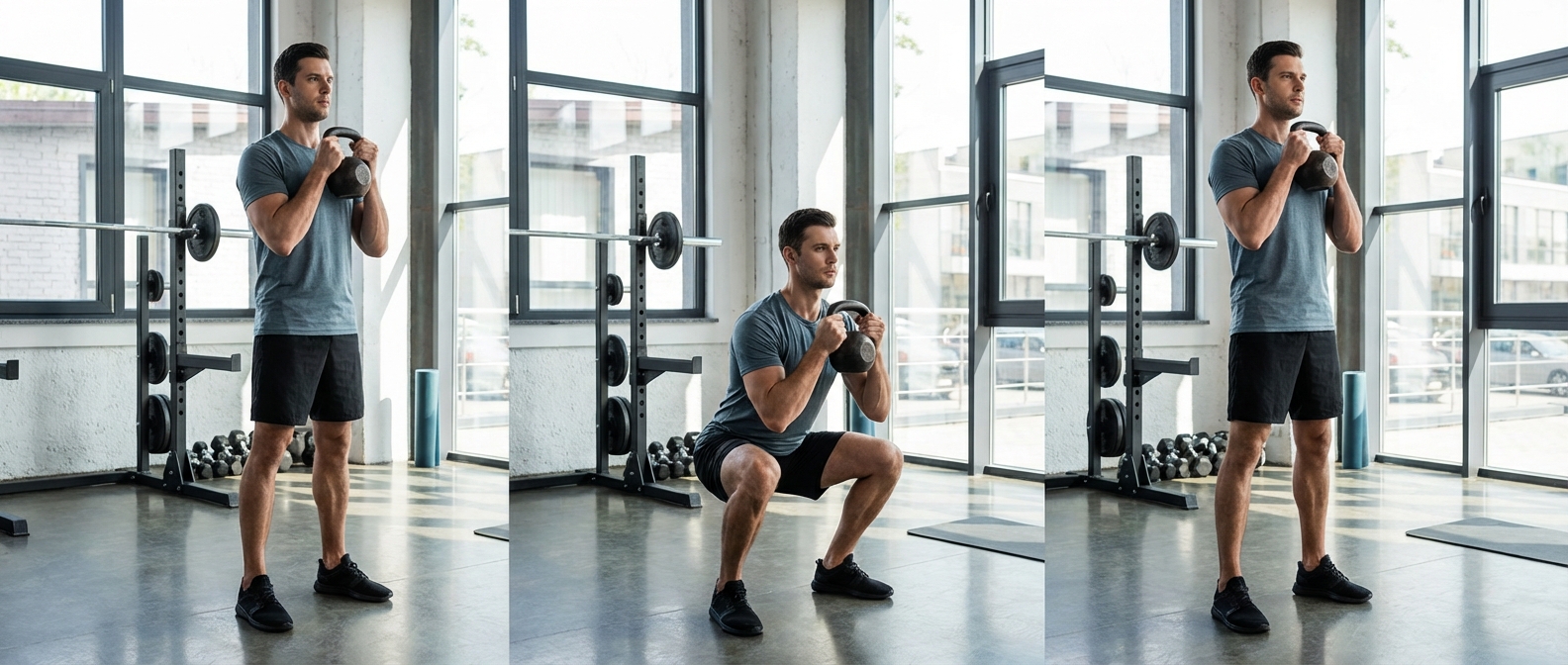
Biomechanical Analysis
Kinetic Chain
This is a closed kinetic chain movement. The anterior placement of the kettlebell shifts the Center of Mass (CoM) forward. To maintain equilibrium, the lifter must maintain a more vertical torso than in a back squat. This shift increases the moment arm at the knee (recruiting quadriceps) while significantly reducing shear force on the lumbar spine.
Pivot Dynamics
Primary rotation occurs at the acetabulofemoral (hip) and tibiofemoral (knee) joints. Critical to depth is the talocrural (ankle) joint; sufficient dorsiflexion is required to allow the knees to track forward, maintaining the vertical torso necessitated by the anterior load.
Stabilization
The load acts as a flexion moment on the thoracic spine. The erector spinae and scapular retractors must work isometrically to maintain thoracic extension. Simultaneously, the anterior core (rectus abdominis) functions as an anti-flexion stabilizer to prevent the torso from collapsing forward.
Muscle Map
Primary Movers
-
Quadriceps Femoris Dominant force producer. Specifically the V. Medialis and V. Lateralis due to the upright knee flexion angle.
-
Gluteus Maximus Primary hip extensor, responsible for the drive out of the bottom position (the "hole").
Synergists & Stabilizers
-
Thoracic Extensors & Upper Back Rhomboids and Trapezius prevent the shoulders from rounding forward under load.
-
Core Complex Rectus Abdominis and Obliques brace to create intra-abdominal pressure.
-
Adductor Magnus Assists in hip extension, especially at the deep point of the squat.
Clinical Execution
The Setup (The Goblet Hold)
Clean the kettlebell to chest height. Hold the horns (sides of the handle) or cup the "bell" itself. Keep your elbows tucked tight against your ribcage. This engages the lats and creates a shelf for the weight. Set your feet slightly wider than shoulder-width with toes turned out 15-30 degrees.
The Eccentric (Descent)
Inhale deeply into your belly to brace. Initiate the movement by breaking at the hips and knees simultaneously. Descend vertically ("elevator," not "escalator"). As you lower, track your knees in line with your toes. Keep your chest tall—imagine showing a logo on your shirt to the wall in front of you.
The Bottom Position (Amortization)
Squat until your elbows touch the inside of your thighs (vastus medialis). Do not rest your elbows on your knees. Use the elbows to gently push the knees outward, opening the hips. Ensure your heels remain flat on the floor.
The Concentric (Ascent)
Drive through the mid-foot/heel. Exhale forcefully as you extend the hips and knees. Maintain the "chest up" position to prevent the weight from pulling you forward. Squeeze the glutes at the top without hyperextending the lumbar spine.
Common Faults & Corrections
| The Fault | Correction | Biomechanical Reality |
|---|---|---|
| Torso Collapse | "Show your chest." Drive elbows up slightly and squeeze shoulder blades. | Insufficient thoracic extension leads to an increased moment arm on the lumbar spine, shifting load to the lower back. |
| Heels Rising | Widen stance slightly. Focus on "screwing feet" into the floor. Address ankle mobility. | Lack of ankle dorsiflexion forces the center of mass too far forward, destabilizing the kinetic chain at the base. |
| Knee Valgus (Caving) | Push knees out towards the pinky toes. Cue "tear the floor apart" with your feet. | Indicates weak gluteus medius/external rotators or adductor dominance, placing shear stress on the medial collateral ligament (MCL). |