Left Side Reverse Lunge
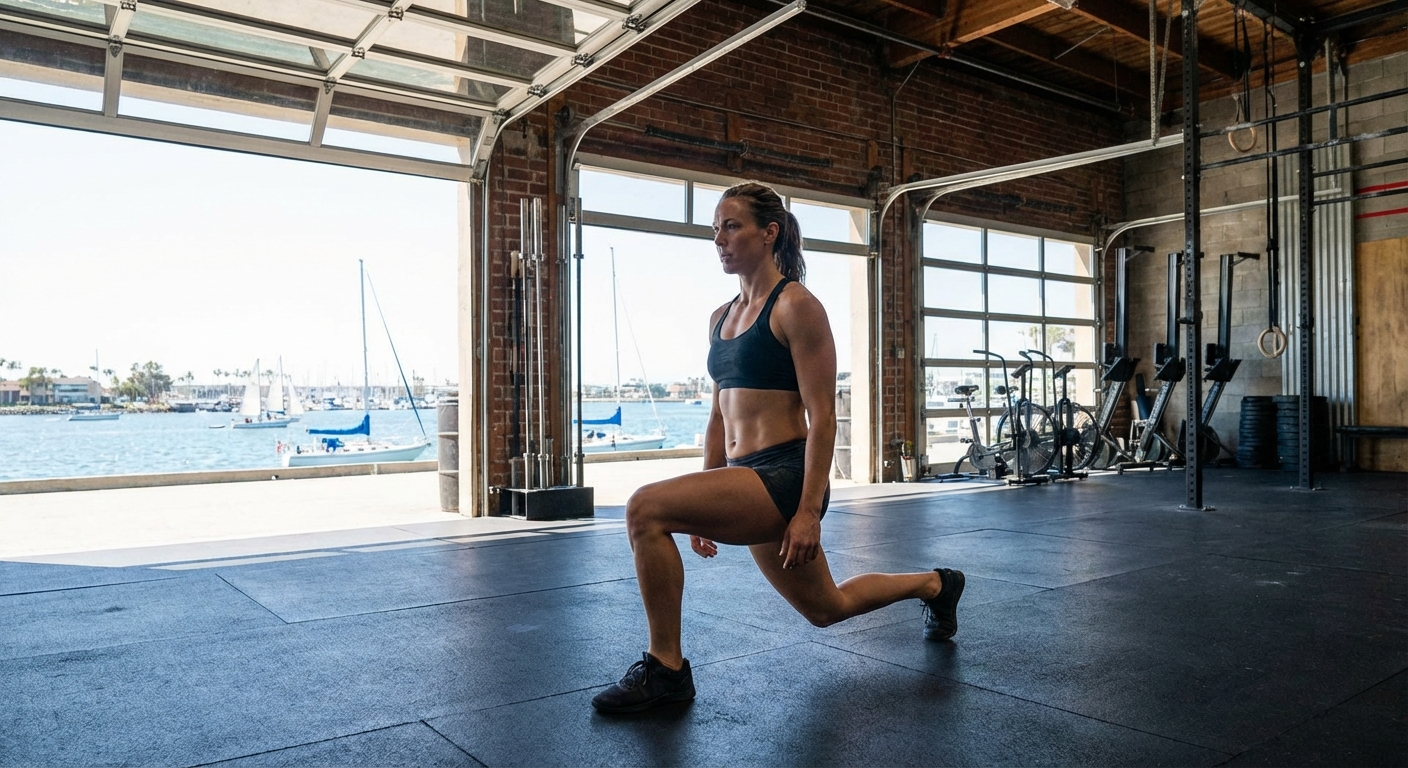
A fundamental unilateral pattern prioritizing the left gluteus maximus and quadriceps while challenging frontal plane stability and core anti-rotation.
Biomechanical Analysis
Kinetic Chain Dynamics
This is a unilateral closed kinetic chain exercise focused on the left lead leg. Force transmits from the ground through the calcaneus (heel) into the left quadriceps and gluteus maximus. The movement relies on the posterior oblique subsystem (connecting the right latissimus dorsi to the left glute) to stabilize the torso against rotational forces.
Critical Angles & Pivots
- • Left Hip Flexion: θ ≈ 90° (Primary load bearing joint).
- • Left Knee Flexion: θ ≈ 90° with patella aligned over the 2nd metatarsal.
- • Left Ankle Dorsiflexion: θ ≈ 15–20° to maintain tibial angle.
- • Right Knee: Flexion θ ≈ 90°, hovering just above the floor.
Physics of the Movement: Torque (τ) & Moment Arms
In the left side reverse lunge, the center of mass moves posteriorly compared to a forward lunge, generally reducing shear stress on the knee (ACL). The moment arm length for the hip extensors is manipulated by torso angle:
A slight forward trunk lean (≈15-20°) increases the horizontal distance between the hip joint and the vertical Ground Reaction Force (GRF), increasing the moment arm for the Left Gluteus Maximus.
Maintaining a perfectly vertical torso shifts the GRF closer to the hip but further from the knee, increasing the internal moment arm for the Left Quadriceps.
Muscular Activation Map
Primary Movers (Agonists)
- Left Gluteus Maximus Hip Extension
- Left Quadriceps Knee Extension
- Left Adductor Magnus Hip Ext/Stabilization
Critical Stabilizers
- Left Gluteus Medius Prevents femoral internal rotation & knee valgus.
- Core (Obliques/Rectus Abd) Resists lateral trunk flexion & lumbar hyperextension.
Secondary / Synergists
- Left Hamstrings (Eccentric control)
- Right Hip Flexors (Eccentric lengthening)
- Left Soleus/Gastrocnemius
- Right MTP Joint (Pivot anchor)
Step-by-Step Execution
The Setup
Stand with feet hip-width apart. Engage your core (brace as if about to be punched) to neutralize the pelvis. Shift your weight slightly onto your left foot.
The Descent (Eccentric Phase)
Step your right foot backward. As the ball of the right foot touches the ground, simultaneously lower the right knee toward the floor. Maintain the majority of your weight (approx. 70-80%) on the stationary left leg.
The Bottom Position
Stop when the left thigh is parallel to the ground (θ ≈ 90°) and the right knee is hovering 1-2 inches off the floor. Ensure the left knee is tracking directly over the second toe, not collapsing inward.
The Ascent (Concentric Phase)
Drive forcibly through the left mid-foot and heel. Think about "pulling" yourself forward with the left hamstring and glute rather than pushing off the back toes. Return to the starting standing position.
Common Mistakes & Troubleshooting
| Error | Biomechanics Consequence | Correction |
|---|---|---|
| Knee Valgus (Caving In) | Excessive strain on the MCL and ACL; indicates weak Left Gluteus Medius. | Cue "drive the left knee out" or "rip the floor apart" with the left foot. |
| "Tightrope" Walking | Narrow base of support drastically increases lateral stability demand, reducing force output. | Step back on "train tracks" (hip width), not a tightrope. |
| Rear Leg Dominance | Pushing off the right toes shifts load away from the target left leg (working leg). | Lift the right toes slightly inside the shoe; visualize the right leg as a "kickstand" only. |
| Lumbar Hyperextension | Arching the low back disengages the anterior core and strains the lumbar spine. | Exhale deeply at the top to bring ribs down; keep pelvis neutral. |