Leg Swings
A foundational ballistic stretching movement designed to optimize dynamic hip range of motion and prime the neuromuscular system for sagittal plane activity.
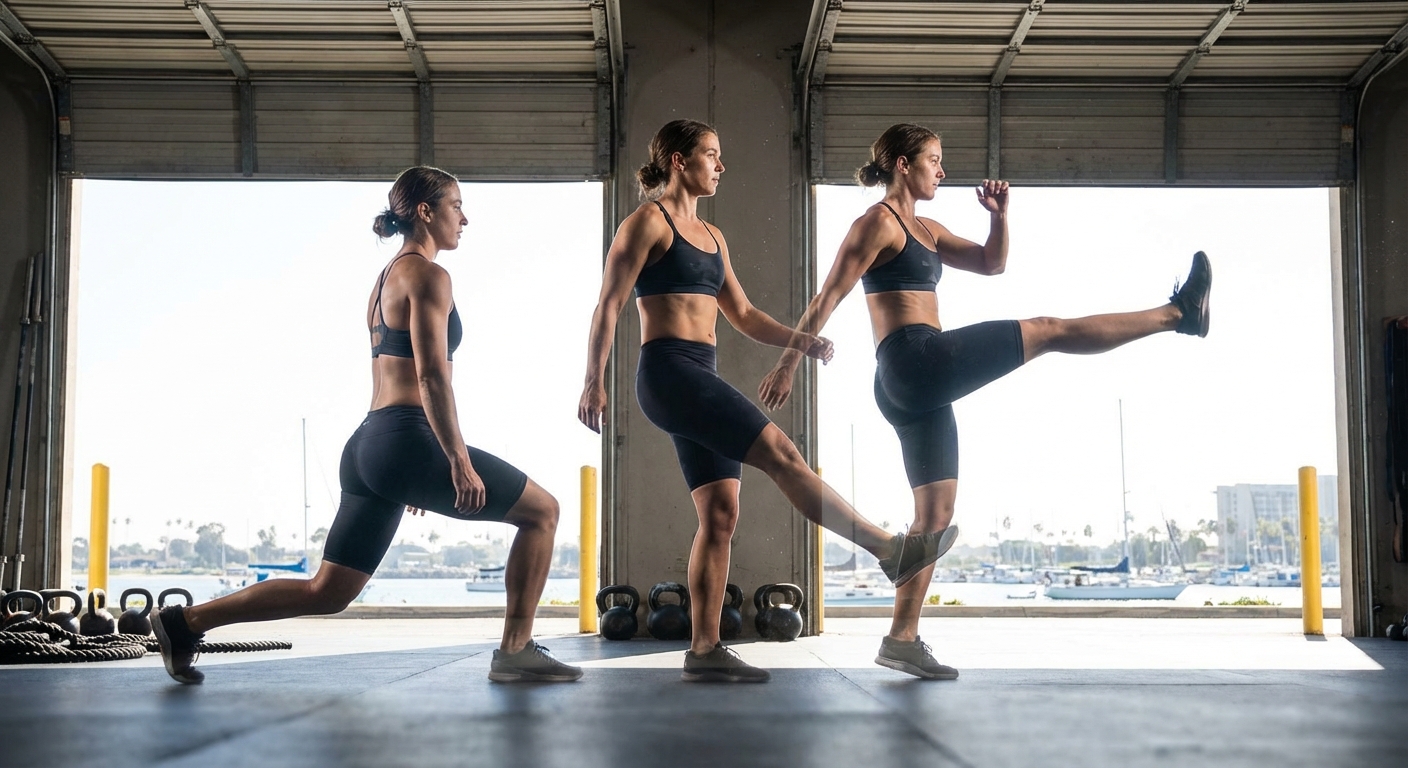
Biomechanics Analysis
This movement utilizes a pendulum-like mechanism to induce reciprocal inhibition and tissue elasticity, preparing the musculotendinous units for high-velocity contractions.
01 Kinetic Chain Dynamics
The exercise presents a dual-nature kinetic demand. The swinging leg operates as an open-kinetic chain system, where the distal segment (foot) moves freely in space, governed by the inertia of the limb mass (m) and velocity (v).
Conversely, the standing leg functions in a closed-kinetic chain. It requires high-threshold isometric stability from the foot intrinsics up to the acetabulum to counteract the rotational torque generated by the swinging limb (τ = r × F).
02 Force Vectors & Stability
Primary Axis: The femoroacetabular joint acts as the fulcrum. The objective is pure sagittal plane rotation (flexion/extension) without transverse or coronal leakage.
Lumbo-Pelvic Dissociation: Critical to performance is the ability to decouple hip motion from lumbar spine motion. The core must generate sufficient anti-extension and anti-flexion force to maintain a neutral spine (θ ≈ 0°) while the hip moves through a large arc (>100°).
The Trendelenburg Constraint
A key biomechanical marker is the stability of the stance hemipelvis. The Gluteus Medius of the standing leg must fire isometrically to prevent the pelvis from dropping on the unsupported side. Failure here results in energy leaks and increased shear force on the lumbar spine.
Neuromuscular Map
Agonists (Dynamic)
- ▸ Iliopsoas & Rectus Femoris: Concentric action drives hip flexion (forward swing).
- ▸ Gluteus Maximus & Hamstrings: Concentric action drives hip extension (backward swing).
- Note: Muscles act as brakes (eccentric) at the end-range of the swing to reverse momentum.
Stabilizers (Static)
- ▸ Gluteus Medius (Stance Leg): Prevents pelvic drop.
- ▸ Transverse Abdominis: Creates intra-abdominal pressure to stabilize the lumbar spine.
- ▸ Erector Spinae: Maintains thoracic extension.
Secondary Movers
- ▸ Sartorius: Assists in flexion.
- ▸ Tensor Fasciae Latae: Assists in flexion and stabilization.
- ▸ Gastrocnemius: Involved in the closed-chain stability of the ankle.
Execution Protocol
-
1
The Setup
Stand perpendicular to a wall or sturdy object. Place your hand on the support for balance, not to bear weight. Establish a "tripod foot" on the standing leg (weight distributed between heel, big toe knuckle, and little toe knuckle).
-
2
Core Brace
Before moving, slightly engage the core to lock the ribcage over the pelvis. This minimizes lumbar compensation. Ensure the standing knee is "soft" (unlocked) but stable.
-
3
The Swing Phase
Begin swinging the outside leg forward and backward. Start with a small Range of Motion (ROM) and gradually increase the amplitude. Keep the torso upright; do not lean forward or backward to fake hip mobility.
-
4
Velocity Control
The movement should be rhythmic and controlled. Avoid aggressive "flinging" at the end ranges. Let the leg swing naturally like a pendulum, actively contracting the glute at extension and the hip flexor at flexion.
Common Pathologies & Corrections
| Error | Biomechanical Consequence | Correction |
|---|---|---|
| Lumbar Hyperextension | The spine extends to compensate for lack of hip extension, causing facet joint compression. | Engage anterior core; limit backward swing range to pure hip movement. |
| Torso Rocking | Momentum shifts from the hip to the trunk, reducing the stretch effect on target tissues. | Visual focus on a fixed point; imagine the torso is a statue while the leg moves. |
| Pelvic Rotation | Transverse plane leakage; reduces sagittal plane efficiency. | Keep headlights (ASIS) of the hips pointing straight forward throughout the swing. |
| Bent Swinging Knee | Shortens the lever arm (r), reducing torque and minimizing hamstring stretch. | Keep the swinging leg relatively straight (soft knee is okay, bent is not). |