Right Side Reverse Lunge
A unilateral dominant lower-body compound movement focusing on right-leg stabilization, gluteal recruitment, and deceleration mechanics.
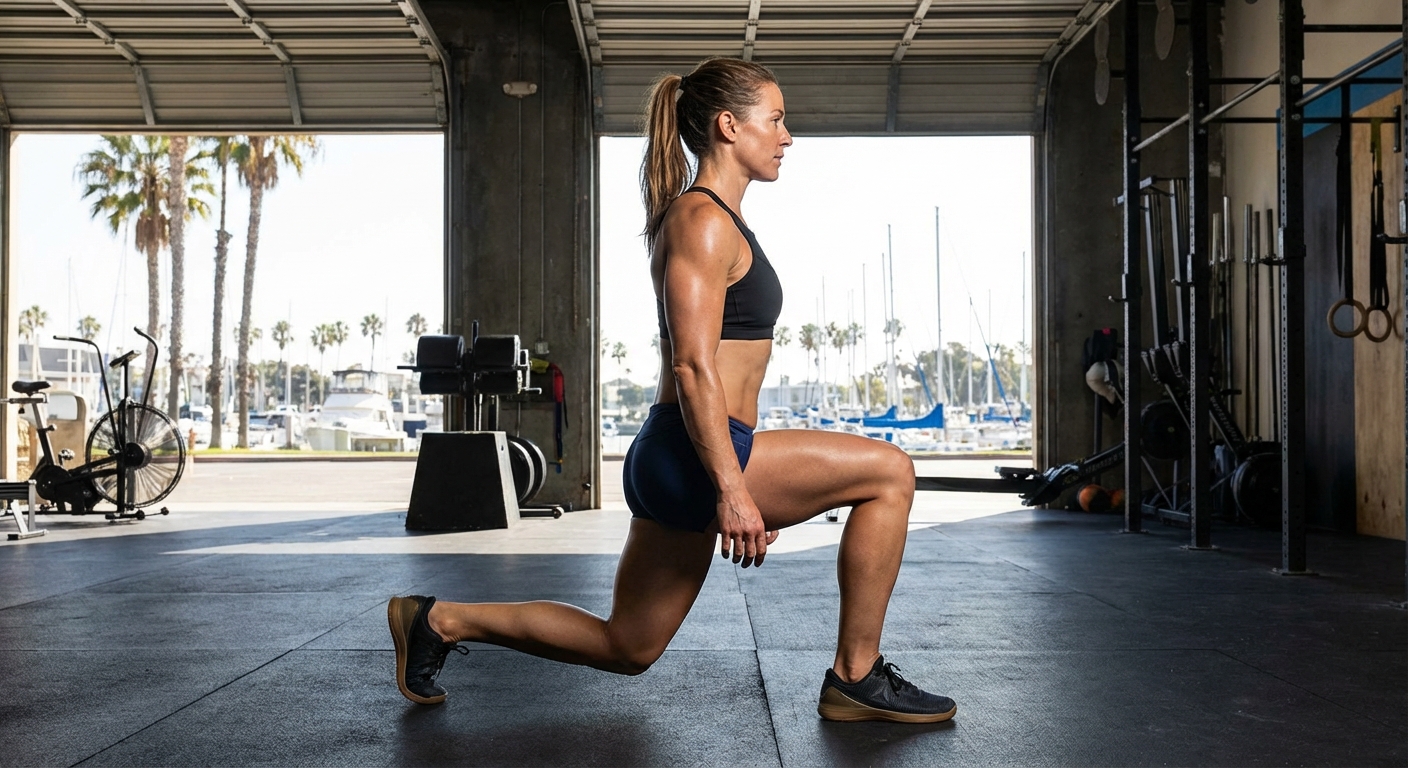
Biomechanics Analysis
A breakdown of forces, levers, and stabilization requirements.
☍ Kinetic Chain
The right leg operates in a Closed Kinetic Chain (CKC) environment. The right foot remains fixed to the ground, facilitating Ground Reaction Force (GRF) transfer vertically through the tibia and femur. The rear leg (left) acts as an open-chain stabilizer until toe contact, functioning primarily as a "kickstand" to manage balance rather than load bearing.
- Primary Load Vector: Vertical (Gravity + GRF)
- Shear Force: Minimized at the right knee compared to forward lunges due to deceleration mechanics.
∠ Pivot Points & Angles
- Right Hip Flexion θ ≈ 90°
- Right Knee Flexion θ ≈ 90°
- Left Knee Position Hover 2–5 cm
- Right Tibia Angle Vertical (90° to floor)
⚖ Stabilization Profile
Pelvic Stability
The Right Gluteus Medius must fire isometrically to prevent the left hip from dropping (Trendelenburg sign) during the single-leg stance phase.
Anti-Rotation
The core requires transverse plane stability to prevent the torso from twisting toward the lead leg.
Eccentric Control
Control of the Left Hip Flexors is required to allow the right hip to descend into flexion without excessive anterior pelvic tilt.
Muscle Activation Map
Targeted musculature during the Right Side Reverse Lunge.
Primary Movers
- Right Gluteus Maximus
- Right Quadriceps (Vastus Complex)
- Right Adductor Magnus
Synergists
- Right Hamstrings
- Right Soleus
- Left Gluteus Maximus (Initial push-off)
Stabilizers
- Right Gluteus Medius & Minimus
- Transverse Abdominis
- Obliques (Internal & External)
Step-by-Step Instructions
Precision execution for maximum hypertrophy and safety.
Setup and Brace
Stand with feet hip-width apart. Engage your core (intra-abdominal pressure) and keep the chest proud. Shift your body weight completely onto your right foot.
Initiate the Step
Reach your left leg backward. As the left leg travels back, simultaneously break at the right hip and right knee. Imagine you are sitting back into a chair with your right glute.
Decelerate (Eccentric)
Lower your hips with control. Maintain a vertical right tibia (shin bone) to minimize shear force on the knee. Continue descending until the right thigh is parallel to the floor and the left knee is hovering 2–5 cm off the ground.
Drive (Concentric)
Drive firmly through the right mid-foot and heel to extend the hip and knee. Do not push off excessively with the back left toes; the left leg should be passive. Return to the starting standing position.
Common Mistakes
Identify and correct these biomechanical faults.
| Fault | Consequence | Correction |
|---|---|---|
| Right Knee Valgus | Increased stress on the MCL and ACL; reduced glute activation. | Drive the right knee outward, aligning it with the 2nd/3rd toe. Engage the right glute medius. |
| Tightrope Walking | Reduced base of support; lateral instability; loss of force production. | Maintain a hip-width stance ("Train tracks," not a "Tightrope") throughout the movement. |
| Lumbar Hyperextension | Compression of lumbar spine; disengagement of core musculature. | Slight forward torso lean (ribcage down) to match the angle of the rear shin. Keep core braced. |
| Back Foot Dominance | Reduces load on the target (right) leg; turns movement into a calf raise for the rear leg. | Visualize the back leg as a kickstand. 80-90% of the weight should remain on the front right foot. |
Master the movement. Control the descent. Own the stability.