Segmental Cat-Cows
Spinal Articulation & Motor Control
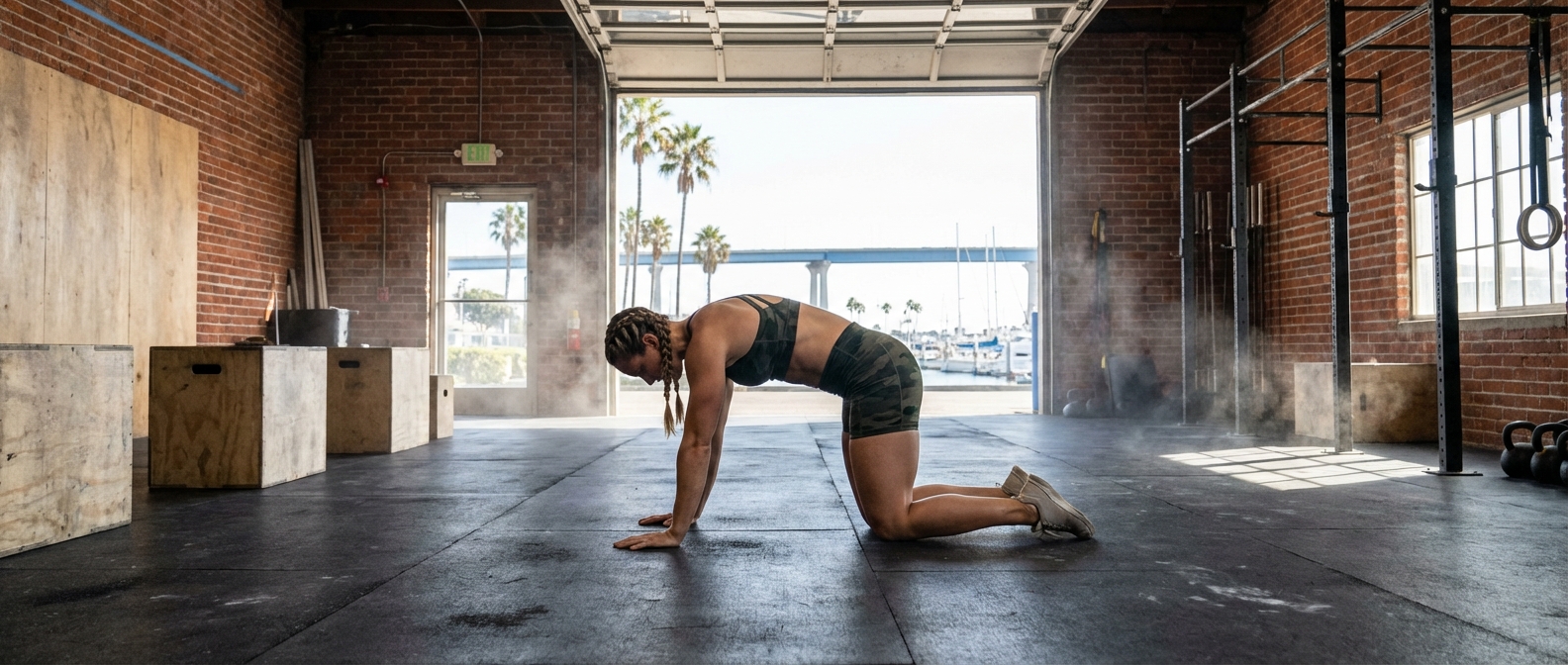
Biomechanics Analysis
Kinetic Chain & Pivots
This movement operates within a Closed Kinetic Chain (CKC) configuration. The hands (glenohumeral support) and knees (femoral-acetabular support) act as fixed anchors. Unlike dynamic loading exercises, the goal here is to minimize movement at these anchor points to isolate the variable axis of rotation along the spinal column.
The Instantaneous Axis of Rotation (IAR) must shift dynamically from the sacrum through the lumbar, thoracic, and cervical vertebrae. This requires the suppression of global torque (moving the whole spine at once) in favor of local, segmental torque generation.
Force Vectors & Stabilization
Force Vectors: Gravity provides a constant vertical force vector (↓) perpendicular to the spine. The erector spinae and abdominals must generate internal force to oppose gravity and manipulate the curvature of the spine against this constant resistance.
Neuromuscular Control: Success is defined by the inhibition of the "global" movers (e.g., longissimus thoracis acting on the whole back) and the sequential activation of local stabilizers (multifidus). This is a test of cortical mapping—your brain's ability to "find" and move individual vertebrae.
Muscle Map
⚡ Primary Movers
- Rectus Abdominis: Primary driver of spinal flexion (The "Cat").
- Erector Spinae: (Spinalis, Longissimus, Iliocostalis) Drivers of spinal extension (The "Cow").
🔄 Secondary Movers
- Internal/External Obliques: Assist in flexion and controlling rotation/shear forces.
- Psoas Major: Assists in initiating lumbar flexion and anterior pelvic tilt.
🛡️ Intrinsic Stabilizers
- Multifidus & Rotatores: The critical "sensors" providing proprioceptive feedback and segment-to-segment control.
- Serratus Anterior: Anchors the scapula to the ribcage to prevent "winging" during thoracic movement.
Execution Protocol
- The Setup: Assume a quadruped position. Place hands directly under shoulders and knees directly under hips. Find a neutral spine position (flat back). Press the floor away to engage the serratus anterior.
- Initiate Flexion (The Cat): Begin strictly at the pelvis. Tuck your tailbone under (posterior pelvic tilt) while keeping the lumbar, thoracic, and cervical spine completely still.
- The Upward Wave: Imagine a wave traveling up your spine. Slowly round the lower back (L5 to L1), then the mid-back (T12 to T1), one vertebra at a time.
- Complete Flexion: The wave finishes at the neck. Tuck your chin to your chest only after the thoracic spine is fully rounded. Push the ground away maximally.
- Initiate Extension (The Cow): Keep the head tucked and upper back rounded. Reverse the movement starting again at the tailbone. Lift the tailbone to the ceiling (anterior pelvic tilt).
- The Downward Wave: Allow the wave of extension to travel upward. Drop the belly (lumbar extension), then arch the chest (thoracic extension).
- Complete Extension: Finally, lift the head and look up, completing the extension wave at the cervical spine.
- Rinse and Repeat: Maintain a slow tempo. If you find a "blind spot" (a section that moves as a block), pause there, breathe, and try to articulate it further.
Common Mistakes
| Error | Correction |
|---|---|
| Hinging (Block Movement) | Moving the spine in large chunks (e.g., all thoracic at once). Slow down significantly and visualize the space between each vertebra expanding. |
| Leading with the Head | Lifting or dropping the head before the wave reaches the neck. Keep the chin tucked/lifted until the movement naturally arrives at the cervical spine. |
| Elbow Compensation | Bending the elbows to create the illusion of more range of motion. Keep elbows locked; all movement must come from the spinal column. |
| Scapular Collapse | Letting the chest sink between shoulders passively. Maintain active push against the floor to stabilize the shoulder girdle. |