Target
Posterior Chain & Core Stability
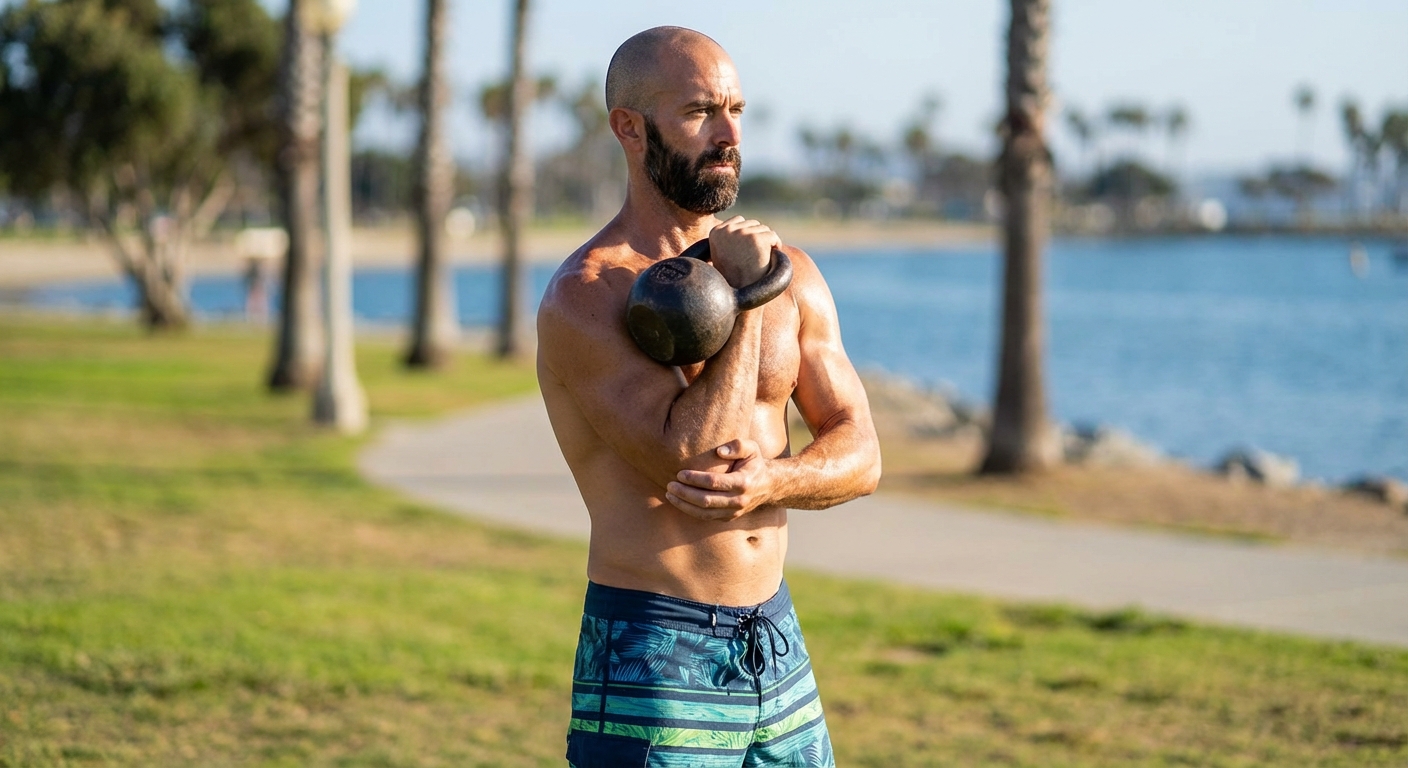
The bridge between the grind and the ballistic. A fundamental movement requiring precise timing to transport the load from the floor to the rack position without impact trauma.
Target
Posterior Chain & Core Stability
The kinetic energy from the hip drive is absorbed into a static stability hold; the load is transferred through a vertical forearm directly into the iliac crest and trunk. This requires immediate deceleration capability.
The elbow must remain tucked tightly against the ribcage (not flared), acting as the primary fulcrum. The wrist maintains a neutral, straight alignment to prevent hyperextension under the bell's mass.
Significant anti-rotational core stability is required to counter the offset load. The latissimus dorsi must contract to 'pack' the shoulder, pulling the scapula down and back to integrate the arm with the torso.
Gluteus Maximus, Hamstrings
Responsible for the explosive hip extension that generates the vertical float.
Upper Trapezius, Latissimus Dorsi
The traps initiate the upward pull slightly, while the lats actively pull the bell back into the rack position.
Internal/External Obliques, Quadratus Lumborum
Prevents the torso from twisting toward the loaded side (Anti-Rotation).
In a swing, the bell travels far from the body. In a clean, you must tame this arc. The moment the hips snap, the elbow must draw back immediately.
Precision over speed. Master the path.
Address the bell as you would a swing. Hinge at the hips, grab the handle with one hand, thumb pointing back. Square your shoulders to the floor.
Hike the kettlebell back between your legs high into the groin (the "zipper" zone). Keep the back flat and the lat engaged.
Snap the hips forward. As the bell floats up, imagine you are zipping up a tight jacket. Keep the elbow close to the body. Do not let the arm swing out.
As the bell reaches chest height, loosen your grip and punch your hand vertically *through* the handle. The bell should roll around the wrist, not flip over it.
Finish with the hand near the sternum, wrist straight, elbow tucked on the iliac crest (or ribs). Body acts as a solid pillar.
| The Error | Biomechanical Consequence | Coach's Cue |
|---|---|---|
| Casting the Bell (Wide Arc) | Increases moment arm, putting strain on the lower back and causing the bell to crash on the forearm. | "Zip up your jacket." / "Tame the arc." |
| Broken Wrist (Hyperextension) | Poor load transfer; risk of wrist injury and creates a weak platform for pressing. | "Knuckles to ceiling." / "Goose neck." |
| Curling the Bell | Using biceps as a primary mover instead of the hips. Fatigue sets in rapidly. | "Hips drive, arm guides." |
| Chicken Winging | Flaring the elbow disconnects the load from the trunk, reducing stability. | "Squeeze your armpit." / "Newspaper under the arm." |
Sources for this exercise are listed on the main exercise page.