Thoracic CARs
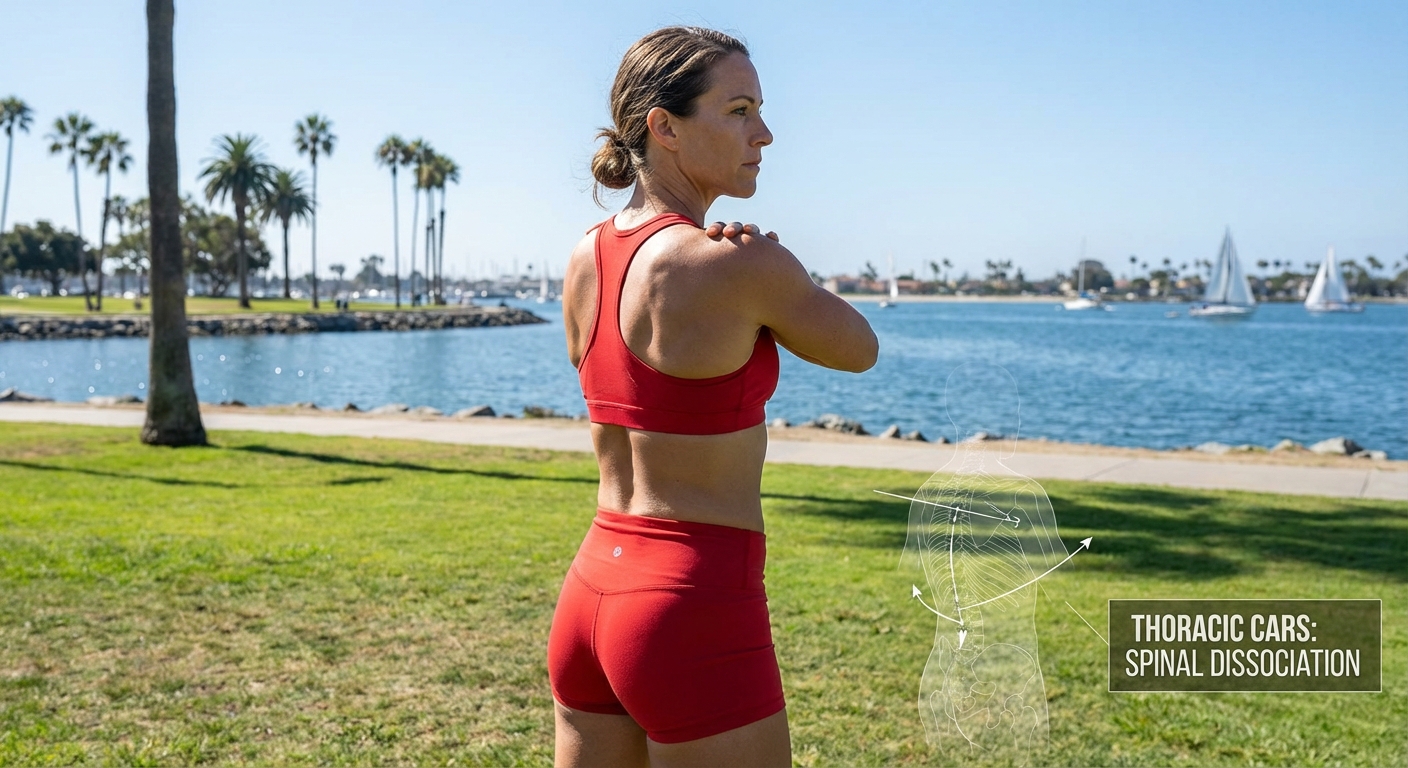
Controlled Articular Rotations for the mid-spine. Isolate the T1–T12 segments to reclaim rotation and extension while bulletproofing the spine.
Biomechanics Deep Dive
Thoracic Controlled Articular Rotations (CARs) are designed to decouple the movement of the thoracic spine (T1–T12) from the cervical and lumbar regions. Biomechanically, the goal is to explore the maximal outer limits of the articular capsule, stimulating mechanoreceptors and improving tissue extensibility.
The Kinetic Cone
The movement traces a "cone" in space. The apex of this cone is the mid-thoracic spine, while the shoulders trace the base. This requires sequential segmental articulation:
- → Flexion (Sagittal Plane)
- → Axial Rotation (Transverse Plane)
- → Lateral Flexion (Frontal Plane)
- → Extension (Sagittal Plane)
Law of Irradiation
To isolate T1–T12, we must utilize the Law of Irradiation. By creating high-threshold isometric tension in the surrounding stabilizers (fists, abs, glutes), we create a "neuro-mechanical lock" on adjacent joints.
Equation of Stability:
Stability (S) ∝ (Tension × Surface Area).
Increased tension in the pelvis = Zero degrees (0°) of lumbar movement allowed.
Coupled Motion Mechanics
In the thoracic spine, lateral flexion and rotation are coupled motions. To achieve true maximal rotation, one must combine it with ipsilateral lateral flexion during the extension phase. The goal is to minimize shear forces on the lumbar spine ($\tau_{L} \approx 0$) while maximizing torque ($\tau_{T}$) in the thoracic vertebrae.
Muscle Map
Primary Movers
- Erector Spinae (Thoracic)
- Intercostals
- Obliques (Internal/External)
The Anchors
These muscles must remain isometrically contracted to prevent compensation.
- Gluteus Maximus
- Rectus Abdominis
- Lumbar Multifidus
Synergists
- • Latissimus Dorsi (Eccentric control)
- • Rhomboids
- • Rotatores
Execution Protocol
1. Irradiation (The Setup)
Assume a seated position (Seiza or cross-legged) or standing. Wrap your arms across your chest in an "X" shape, hugging your shoulders. Inhale deeply into the lower abs, pack the air down, and tense your glutes and abs to 30-50% tension.
2. Segmental Flexion
Exhale and round the upper back forward. Think about moving one vertebra at a time from the base of the neck (C7) down to the bottom of the ribs. Do not let the hips hinge.
3. Rotation to Lateral Flexion
Maintain flexion and rotate your sternum to the right. Once you hit your rotational limit, dip your right shoulder toward your right hip (Lateral Flexion). Visualize dropping your shoulder into your back pocket.
4. Extension Arc
Begin to extend the spine (arch back) while rotated. Imagine drawing a circle on the ceiling with your sternum. Transition smoothly across the back, extending fully until you reach the left side lateral flexion position.
Note: Ensure the extension comes from the upper back, not the lower back.
5. Return and Reverse
Rotate the sternum back to the center while in flexion to complete the circle. Re-brace and perform the repetition in the opposite direction (Counter-Clockwise).
Common Mistakes & Corrections
| The Error | Why it happens | The Fix |
|---|---|---|
| "Hula Hooping" | Pelvis shifts side-to-side to fake movement range. | Squeeze a yoga block between your knees; squeeze glutes harder. |
| Lumbar Extension | L1-L5 compensates for lack of T-spine mobility. | Keep the ribs knitted down in the front; focus on extending only the "bra line" up. |
| Cervical Leading | Head moves before the spine, creating false rotation. | Tuck the chin slightly; keep the nose aligned with the sternum (the "Sternum-Nose Link"). |
| Holding Breath | Excessive Valsalva maneuver during low load. | Breathe shallowly ("sipping air") behind the shield of abdominal tension. |