Tibial CARs
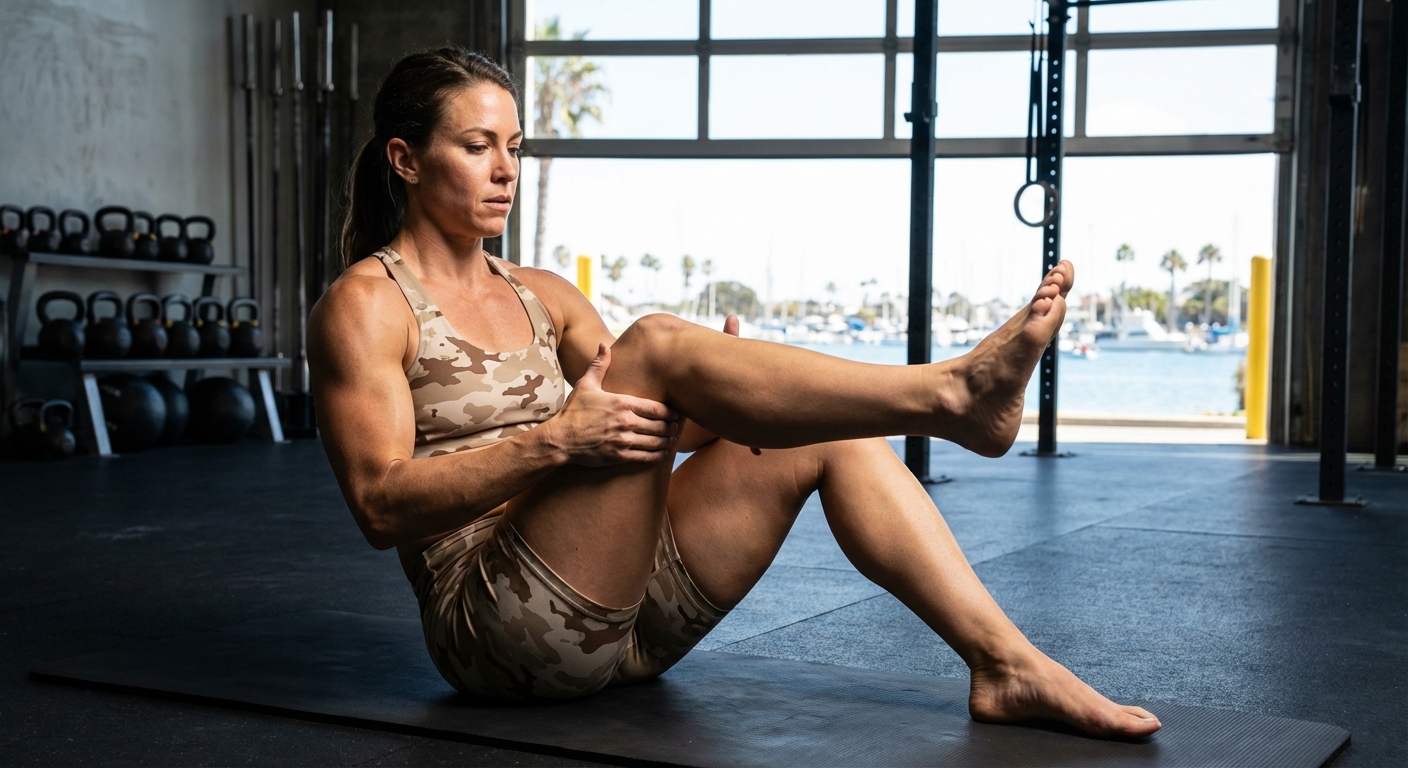
Controlled Articular Rotations
Isolating Tibiofemoral Rotation
Biomechanics Deep Dive
The Modified Hinge Joint
While the knee is often simplified as a hinge joint (ginglymus), it is technically a modified hinge joint. This classification acknowledges that while flexion and extension are the primary movements, the joint possesses a crucial secondary degree of freedom: axial rotation. This rotation occurs along the longitudinal axis of the tibia pivoting upon the femoral condyles.
Forces & Dissociation
Tibial CARs operate within an Open Kinetic Chain (OKC). The primary biomechanical objective is dissociation. The goal is to generate torque (τ) via the hamstrings and popliteus to rotate the tibia without recruiting the hip rotators or the ankle invertors/evertors.
Torque Formula: τ = r × F
Here, r is the moment arm from the center of the tibial plateau to the insertion of the hamstrings, and F is the contractile force of the muscle.
The Locking Mechanism
Rotation is maximal when the knee is flexed (typically at 90°). As the knee approaches full extension (0°), the "Screw-Home Mechanism" engages, externally rotating the tibia to lock the joint for stability. Therefore, Tibial CARs must be performed in flexion to disengage the collateral ligaments and allow the menisci to glide, permitting approximately 40°–50° of total rotation.
Muscle Map
Primary Movers
- • Biceps Femoris: Responsible for External Rotation of the tibia.
- • Semitendinosus/Semimembranosus: Responsible for Internal Rotation.
- • Popliteus: The key "unlocker" of the knee; initiates Internal Rotation.
Stabilizers
- • Quadriceps: Maintains isometric tension to stabilize the patella.
- • Hip Rotators (Glute Med/Min): Act isometrically to prevent the femur from rotating, ensuring movement is isolated distally.
Synergists & Cues
- • Tibialis Anterior: Dorsiflexing the ankle (pulling toes up) "locks" the ankle joint, helping to ensure rotation comes from the knee, not the foot.
- • Biceps Brachii: Used manually to headlock the thigh, creating a physical block against hip movement.
Step-by-Step Instructions
The Setup
Sit on the floor. Bend one knee to approximately 90°. Slide your same-side arm underneath your thigh and grab your opposite bicep (creating a "headlock" on your own leg). Place your other hand on your tibial tuberosity (the bump just below the knee cap) to monitor movement.
Irradiation & Ankle Lock
Dorsiflex your ankle (pull toes toward the shin). This locks the ankle joint and minimizes the chance of simulating rotation through the foot. Generate full-body tension (irradiation) to freeze the hip in place.
External Rotation
Without moving your thigh, attempt to rotate your shin bone outward. Visual cue: Try to point your tibial tuberosity toward the outside of your body. Your foot will point out, but ensure the motion originates from the knee.
Internal Rotation
Slowly reverse the motion. Rotate the shin bone inward. Visual cue: Point the tibial tuberosity toward your other leg. Squeeze the inner hamstrings at the end range.
Axial Cycles
Move back and forth between maximum internal and external rotation. Imagine you are wringing out a towel inside your knee joint. Keep the movement slow and controlled (viscous).
Common Mistakes
| Error | Correction & Cue |
|---|---|
| Ankle Dissociation Failure |
The Issue: Moving the foot side-to-side (inversion/eversion) rather than rotating the shin. The Fix: Keep the ankle rigidly dorsiflexed at 90°. Watch the tibial tuberosity; if that bump isn't moving, the knee isn't rotating. |
| Femoral Drift |
The Issue: The thigh sways left and right to mimic rotation. The Fix: Tighten the "headlock" on your thigh. Imagine your femur is a steel rod stuck in cement. |
| Extension Locking |
The Issue: Extending the leg too straight. The Fix: Keep the knee bent at least 90°. Rotation is physically impossible at full extension due to ligament tautness. |
| Speed |
The Issue: Bouncing back and forth. The Fix: Slow down. Imagine moving through wet cement. High tension, low speed. |