Unweighted Good Mornings (with Bar)
A foundational posterior chain exercise focusing on the hip hinge pattern, spinal integrity, and hamstring elasticity.
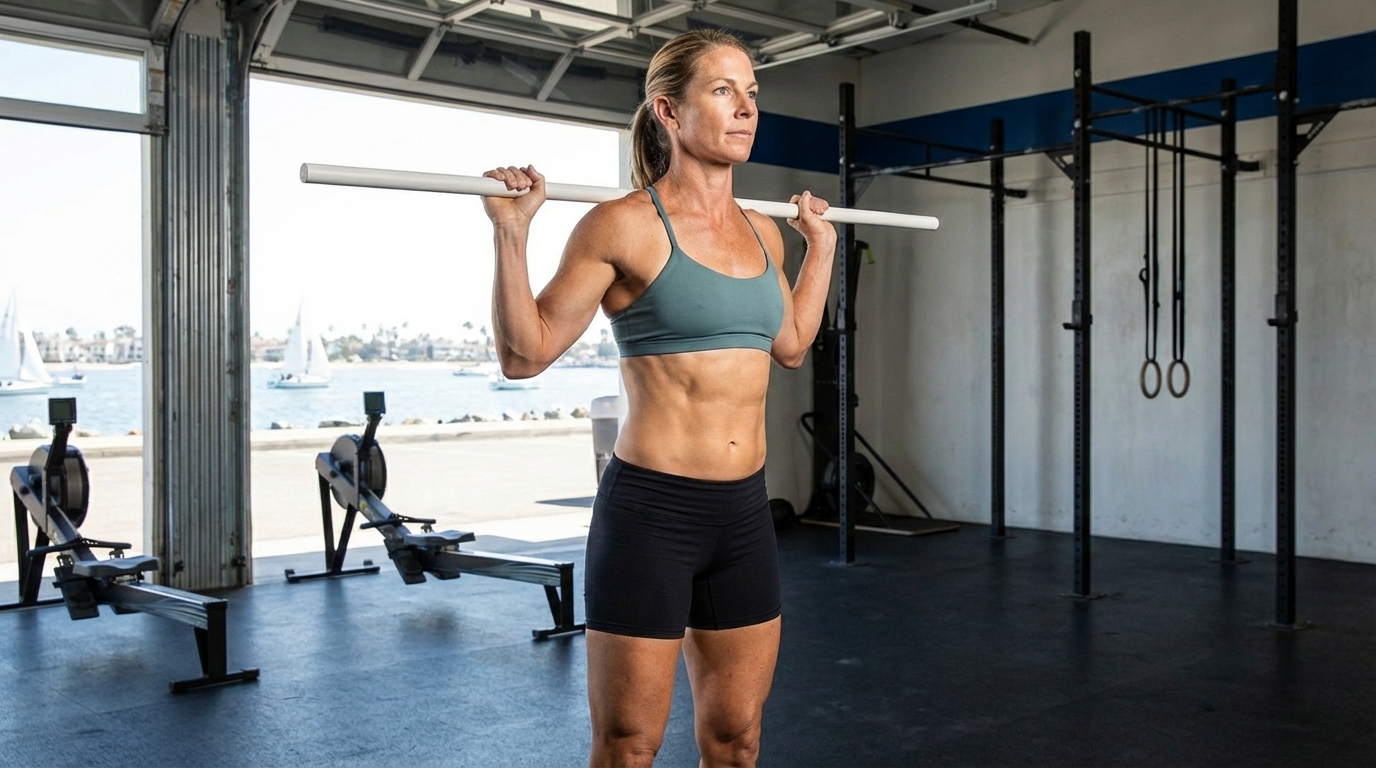
Biomechanics Analysis
The Moment Arm & Torque
The Good Morning creates the longest possible lever arm for the spine. The load (bar) is placed on the upper back (thoracic shelf), while the axis of rotation is the acetabulofemoral joint (hip).
Physics Note: Even with an empty bar, Torque (τ) = Force × Distance. Because the distance between the hips and the bar is maximized, shear forces on the lumbar spine are high, necessitating intense isometric contraction of the erector spinae.
Kinetic Chain Dynamics
This is a Closed Kinetic Chain movement. The feet are fixed, and force is transmitted through the floor. It is distinct from a squat because the primary displacement of the Center of Mass (COM) is horizontal (anterior-posterior), not vertical.
Joint Angles & Pivots
Primary Pivot: Hip flexion ranging from 0° (standing) to ~90° (depending on hamstring extensibility).
Secondary Constraint: The knees must remain in a "soft" extended position (~170°–175°). They do not flex significantly; if they do, the movement shifts load from the hamstrings to the quadriceps.
Stabilization Mechanics
Intra-Abdominal Pressure (IAP): Critical for neutralizing anterior pelvic tilt.
Scapular Retraction: Retracting the scapula creates a rigid shelf for the bar, preventing thoracic kyphosis (rounding of the upper back) which can cascade into lumbar flexion.
Muscle Map
Prime Movers (Agonists)
- Gluteus Maximus
- Hamstrings (Biceps Femoris, Semitendinosus, Semimembranosus)
- Adductor Magnus
Deep Stabilizers
- Erector Spinae (Isometric extension)
- Multifidus
- Transverse Abdominis
Upper Back
- Trapezius
- Rhomboids
- Posterior Deltoids
Step-by-Step Execution
The Setup
Place the empty barbell or PVC pipe across the rear deltoids (similar to a low-bar squat position) or the upper traps. Retract your shoulder blades to create a muscular "shelf." Stance should be between hip-width and shoulder-width, with toes pointing forward or slightly out.
The Brace & Unrack
Inhale deeply into the diaphragm to create intra-abdominal pressure. Brace your core as if expecting a punch. Stand tall, ensuring the ribs are stacked over the pelvis. Unlock your knees slightly—about 5–10 degrees of flexion—and freeze them there.
The Hinge (Descent)
Initiate movement by pushing the hips straight back. Imagine trying to close a car door behind you with your glutes. The torso will naturally incline forward. Keep the weight distributed on the mid-foot to heel. Do not let the knees bend further.
The Turnaround Point
Stop when you feel a significant stretch in the hamstrings or if you feel your lower back beginning to round. For most, this occurs when the torso is between 45° and parallel to the floor. Do not sacrifice spinal neutrality for depth.
The Ascent
Drive the hips forward powerfully. Think about "squeezing the glutes" to return the torso to an upright position. Maintain the core brace until you are fully standing.
Common Mistakes & Corrections
| The Mistake | The Consequence | The Fix |
|---|---|---|
| Squatting the weight | Knees travel forward; load shifts to quads, bypassing hamstrings. | Keep shins vertical. Push hips back, not down. |
| Spinal Flexion (Rounding) | Dangerous shear force on lumbar discs; loss of core tension. | Chest out ("Superman chest"). Reduce range of motion. |
| Looking Up (Cervical Extension) | Disrupts neural drive; strains neck muscles. | Tuck the chin. Keep neck aligned with the spine. |
| Weight on Toes | Loss of balance; decreased posterior chain activation. | Shift weight to heels. Lift big toes inside shoes if needed. |