Biomechanics Deep Dive
Glenohumeral Circumduction
This movement takes the humerus from flexion (overhead) into extension (behind the back) via abduction. It flushes synovial fluid through the joint capsule and tests the capsule's elasticity at the extremes of motion.
Constant Tension
Unlike a PVC pipe pass-through, the band provides accommodating resistance. As you widen your grip to pass the "sticking point," the band creates a lateral distraction force, which engages the posterior deltoids and prevents impingement.
Scapular Rhythm
The scapula must elevate and upwardly rotate as the arms rise, then retract and depress as the band passes behind the head. Proper execution ensures the scapula glides freely on the ribcage (scapulothoracic joint).
Muscle Map
While often viewed as a stretch, the banded pass-through is an active mobility drill requiring coordinated firing of the entire shoulder girdle.
Primary Movers (Dynamic)
Anterior, Lateral, and Posterior Deltoids.
Target Tissues (Stretch)
Pectoralis Major (Clavicular & Sternal heads), Pectoralis Minor, Anterior Deltoid.
Stabilizers
Rotator Cuff (Supraspinatus, Infraspinatus, Teres Minor, Subscapularis), Lower Trapezius, Serratus Anterior.
Coach's Insight
"The most critical moment is the transition behind the head. If the traps shrug up into the ears, we lose scapular depression. Keep the neck long."
Execution Guide
-
1
The Setup
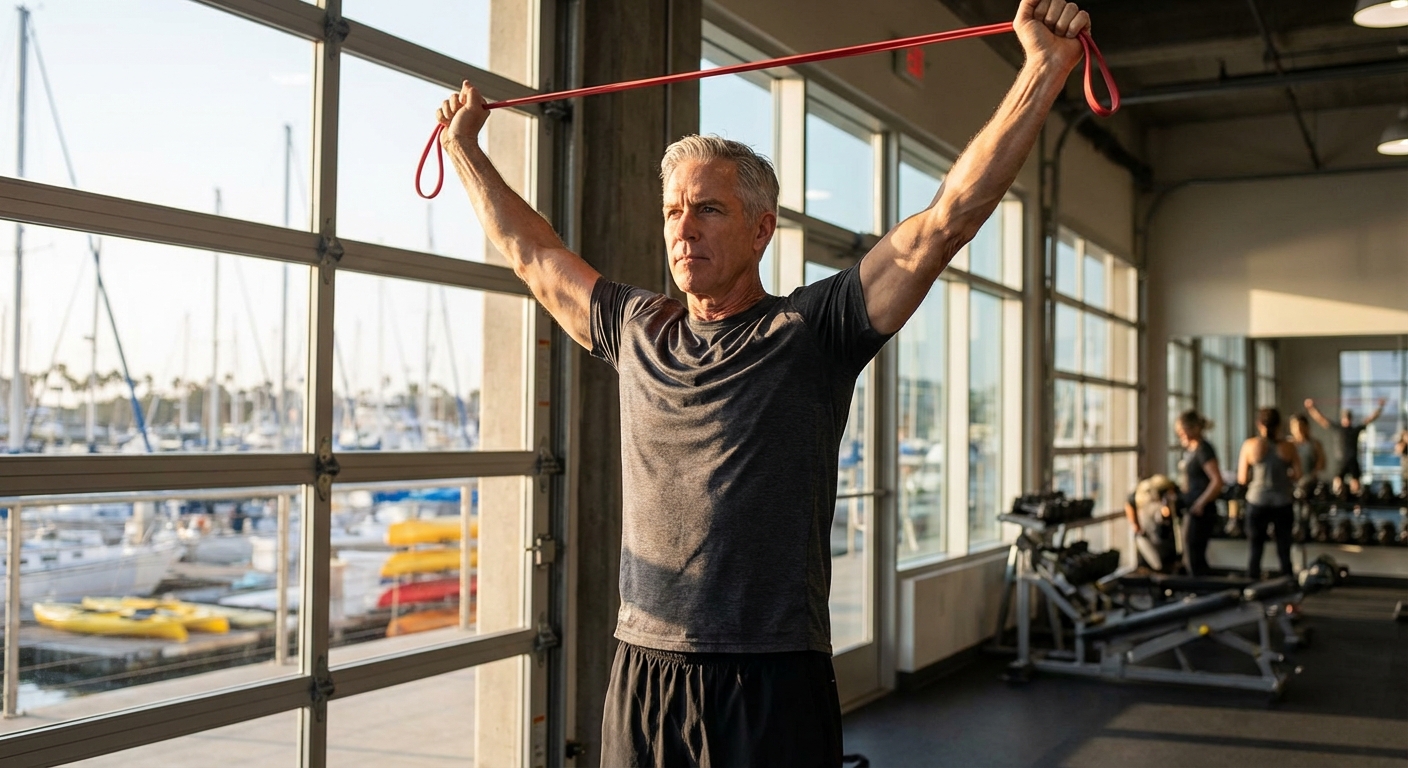
Stand tall with feet hip-width apart. Grip a light resistance band with hands wider than shoulder-width. Ensure the band is taut but not stretched tight at the start position (in front of hips).
-
2
Elevation
Keeping your elbows locked (straight arms), raise the band overhead. Engage your core (ribs down) to prevent your lower back from arching.
-
3
The Pass-Through
As you pass the band behind your head, actively pull the band apart laterally. This creates space in the shoulder joint. Rotate the arms all the way down until the band touches your lower back/glutes.
-
4
The Return
Reverse the motion, bringing the band back overhead and down to the front of the hips. That is one repetition. Perform 10 controlled reps.
Common Mistakes
| Error | Correction |
|---|---|
|
Bending the Elbows
Usually happens at the "sticking point" behind the head.
|
Widen your grip on the band. The goal is straight-arm mobility, not forcing a narrow grip. |
|
Rib Flare
Arching the lower back to compensate for tight shoulders.
|
Squeeze your glutes and brace your abs. Only go as far back as you can without the ribs popping up. |
|
Forward Head Posture
Jutting the chin forward as the band passes behind.
|
Keep the chin tucked (double chin cue). If the head must move, your grip is too narrow. |
|
Rushing the Reps
Using momentum to swing the band over.
|
Slow down. Use a 2-second count up and a 2-second count down. Focus on the tight areas. |