Adductor Rocking
A foundational mobility drill designed to restore acetabulofemoral range of motion and dynamically lengthen the medial thigh musculature.
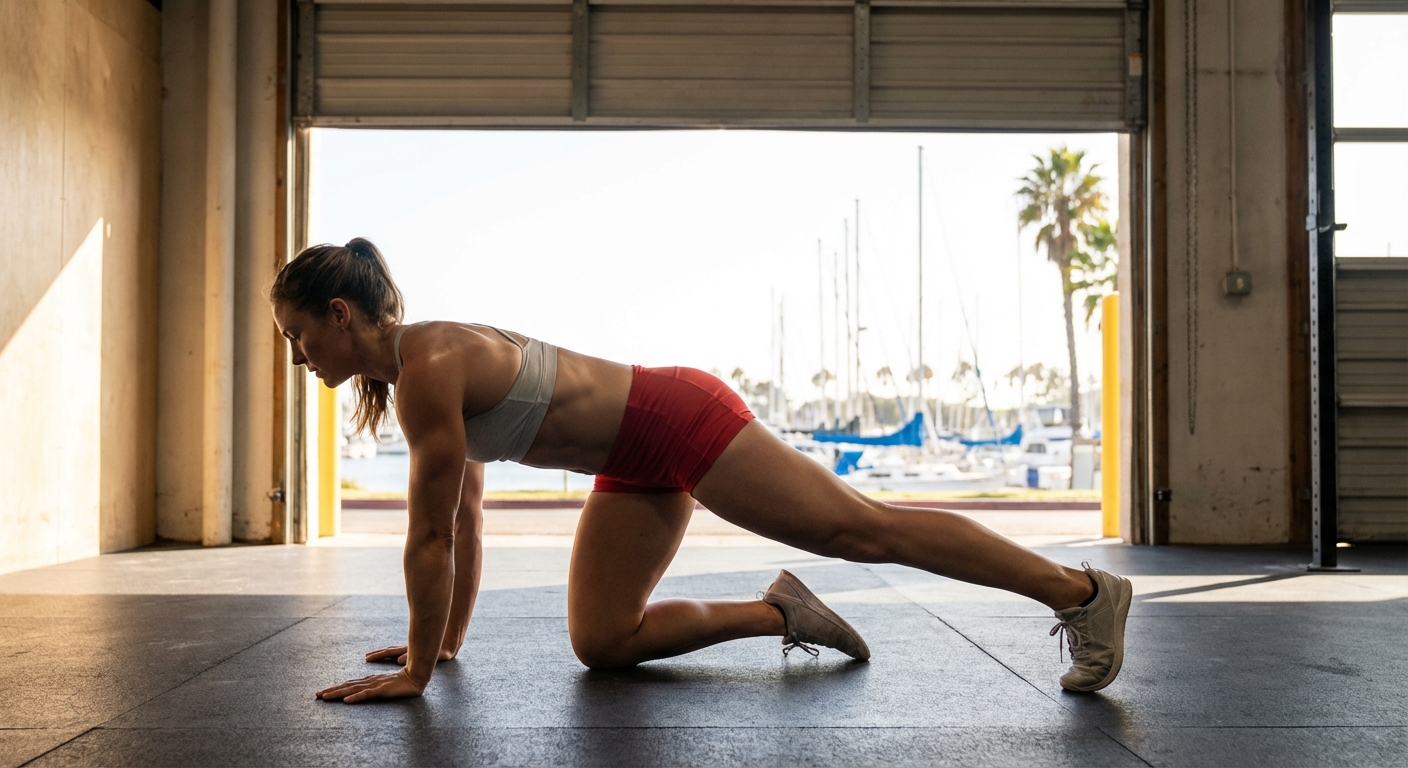
Biomechanics Analysis
The Adductor Rocking exercise operates within a Closed Kinetic Chain (CKC) environment. Unlike open-chain adductor isolation, this movement fixes the distal segment (the foot/knee contact points) while moving the proximal segment (the pelvis). This configuration mimics functional athletic demands and allows for safer, autoregulated stretching.
Kinetic Chain & Lever Arms
The extended leg functions as a long lever arm. As the pelvis translates posteriorly, the moment arm relative to the adductor insertion points changes. This creates a shear force that is converted into tensile stress along the medial fascial line.
- Fulcrum: Acetabulofemoral (Hip) Joint.
- Load: Eccentric tension in the adductors.
- Force Vector: Horizontal translation (posteriorly).
Joint Dynamics & Angles
The primary rotation occurs at the hip. The kneeling leg acts as a secondary hinge with knee flexion (θ ≈ 90° to 130°).
Torque Relationship: τ = F × d
As the center of mass moves away from the kneeling knee, the demand on the core to maintain pelvic neutrality increases.
Muscle Map
Primary Target (Eccentric Load)
-
1
Adductor Magnus Ideally targeted due to its hamstring-like extensor portion. As hips flex (rock back), the magnus lengthens significantly.
-
2
Adductor Longus & Brevis Provide medial tension near the pubic symphysis.
-
3
Gracilis The only bi-articular adductor crossing the knee; highly active when the extended leg remains straight.
Stabilizers (Isometric)
- Lumbopelvic Complex Transverse Abdominis and Multifidus must fire to prevent lumbar flexion (rounding) or excessive anterior pelvic tilt.
- Gluteus Medius Stabilizes the pelvis of the kneeling leg to prevent lateral shifting.
Execution Protocol
Quadruped Setup
Begin on all fours (hands under shoulders, knees under hips). Ensure your spine is neutral—flat like a table. Brace your core lightly.
Extension and Abduction
Extend one leg directly out to the side. The foot of the extended leg should be flat on the floor, toes pointing forward (parallel to your spine). This aligns the adductor fibers for optimal lengthening.
The Posterior Rock
Maintain a neutral spine and slowly push your hips backward toward the heel of the kneeling leg. Imagine pushing your tailbone straight back.
Dynamic Return
Once you feel a strong stretch in the inner thigh (without pain), squeeze your glutes to drive the hips forward back to the starting position. Exhale as you rock back; inhale as you return.
Common Mistakes & Corrections
| Error | Biomechanical Consequence | Correction |
|---|---|---|
| Lumbar Flexion (Butt Wink) | Reduces stretch on adductor magnus; places shear force on lumbar discs. | Stop the rock before your lower back rounds. Keep chest up. |
| Knee Flexion (Extended Leg) | Shortens the lever arm and gracilis muscle, minimizing the stretch. | Lock the knee of the extended leg. Engage the quadriceps. |
| Hyperextension (Sway Back) | Jams lumbar facets; creates false range of motion without hip mobility. | Brace the core (ribs down) before initiating movement. |
| Ballistic Bouncing | Triggers the myotatic (stretch) reflex, causing muscles to contract rather than relax. | Move with a slow, controlled tempo. Think "hydraulic" movement. |
"Think of your extended leg as an anchor. The foot should not slide. The movement comes entirely from the hip hinge. If you feel pinching in the hip capsule rather than a muscle stretch, adjust the angle of the extended leg slightly forward or backward."