Barbell Back Squat
The definitive compound movement for lower body hypertrophy and total force production.
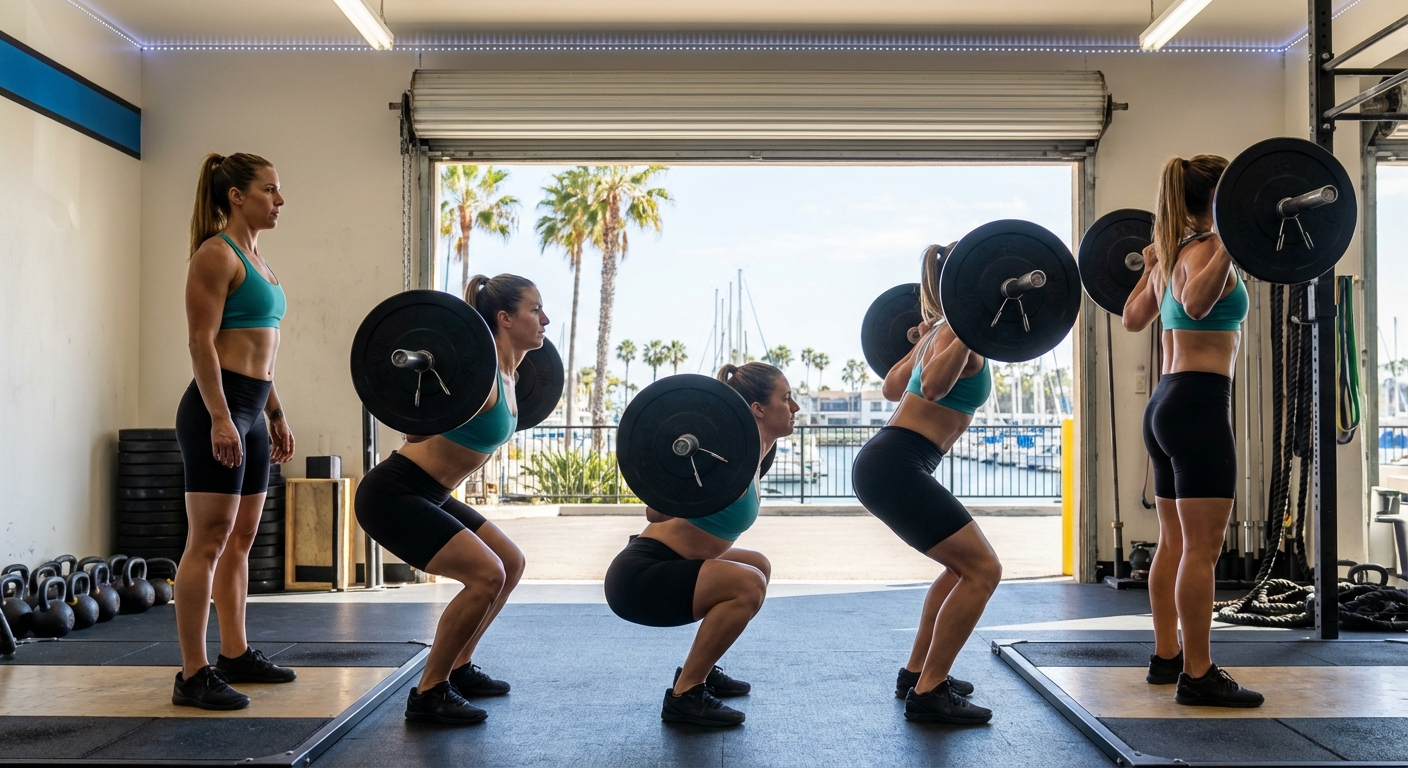
Biomechanics Analysis
Kinetic Chain & Pivots
The squat is a closed kinetic chain movement relying on synchronous triple extension. The primary pivot points operate as a system of levers:
- • Acetabulofemoral (Hip): Requires flexion > 100° to achieve proper depth. The moment arm here is determined by the horizontal distance from the barbell to the hip joint.
- • Tibiofemoral (Knee): Flexion reaches ~110-130° at the bottom of the "hole". High shear forces are managed by co-contraction of hamstrings/quadriceps.
- • Talocrural (Ankle): Approximately 20° of dorsiflexion is required to allow the knees to track forward, maintaining an upright torso.
Torque & Moment Arms
Torque (τ) is the product of Force and the perpendicular distance (moment arm) from the axis of rotation. In the squat, gravity creates a vertical force vector through the barbell.
The Low Bar position increases the hip moment arm (τ_hip > τ_knee), recruiting more posterior chain. The High Bar position maintains a more vertical torso, increasing the knee moment arm (τ_knee) and emphasizing quadriceps output.
Stabilization Physics
The spine acts as a rigid column. Isometric contraction of the transverse abdominis creates intra-abdominal pressure (Valsalva), neutralizing shear forces on the lumbar vertebrae. The thoracic shelf acts as the load-bearing fulcrum.
Muscle Activation Map
Prime Movers (Agonists)
- Quadriceps Femoris Vastus Lateralis, Medialis, and Intermedius drive knee extension.
- Gluteus Maximus The primary engine for hip extension, most active coming out of the hole.
- Adductor Magnus A massive hip extensor often overlooked; assists heavily in the deep squat position.
Synergists
- Soleus & Gastrocnemius Stabilize the ankle joint and assist in plantar flexion during the drive.
- Hamstrings Due to Lombard's Paradox, they act primarily as dynamic stabilizers for the knee rather than prime movers.
Stabilizers
- Erector Spinae Resists spinal flexion under load.
- Transverse Abdominis Generates Intra-Abdominal Pressure (IAP).
- Trapezius & Rhomboids Isometrically contract to create the "shelf" for the bar.
Clinical Execution Protocol
The Setup
Set the bar at mid-sternum height. Step under the bar and retract your scapulae to create a muscular shelf. Unrack with hips and knees (not the lower back).
The Walkout
Take exactly three steps: one back, one to set stance width (typically shoulder-width), and one to align. Screw feet into the floor to activate external rotators.
Brace & Descent (Eccentric)
Inhale deeply into the belly (360° expansion) and brace. Unlock hips and knees simultaneously. Control the descent, ensuring knees track over the toes (femur aligned with metatarsals).
The Drive (Concentric)
Once hip crease passes below the top of the knee, drive straight up. Visualize pushing the floor away. Exhale only upon passing the "sticking point" near the top.
Pathology & Correction
| Error | Biomechanical Failure | Correction |
|---|---|---|
| Knee Valgus (Collapse) | Weak gluteus medius or lack of external rotation torque causes internal femur rotation. | Cue "spread the floor" with your feet; drive knees outward during the ascent. |
| Butt Wink | Posterior pelvic tilt at the bottom of the squat, causing lumbar flexion under load. | Limit depth to neutral spine capacity; improve ankle mobility; widen stance slightly. |
| "Good Morning" Squat | Hips rise faster than the chest (knee extension without hip extension), shifting load to lower back. | Strengthen quadriceps; focus on driving the upper back into the bar immediately out of the hole. |
| Heels Lifting | Insufficient ankle dorsiflexion range of motion (talocrural restriction). | Perform ankle mobility drills; utilize weightlifting shoes with a raised heel. |