Barbell Bench Press
The definitive guide to the king of upper body pressing exercises, optimizing force production through scapular stability and leg drive.
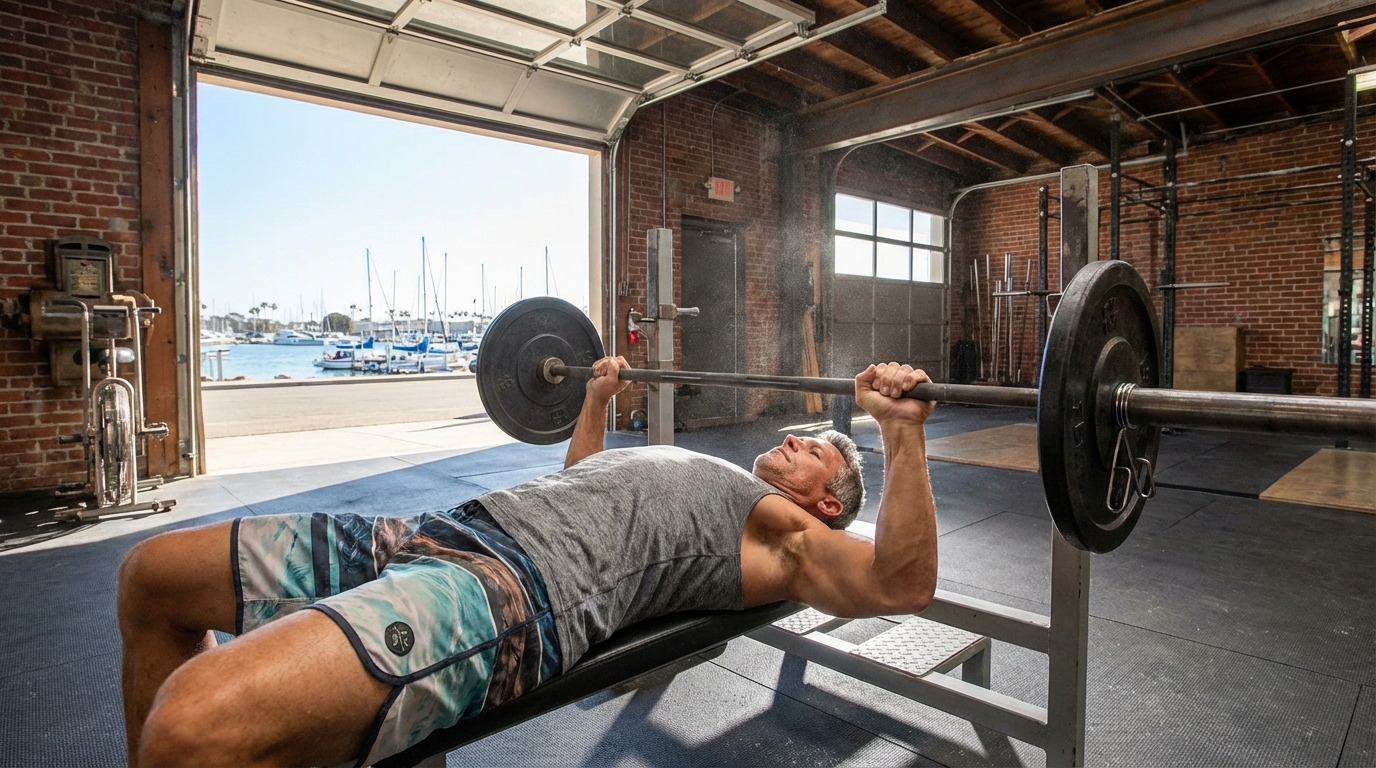
Biomechanics Analysis
The Kinetic Chain
The bench press is often mistaken for an isolation chest exercise, but mechanically, it is a full-body integration. The movement initiates with leg drive, generating ground reaction force that transfers horizontally through the femur into the hips. This force travels through a rigid torso—created by a slight thoracic arch and intra-abdominal pressure—directly to the retracted scapulae.
The scapulae act as the "brakes" and the stable platform against the bench. From this anchored position, force is expressed through the glenohumeral joint (shoulder horizontal adduction) and humeroulnar joint (elbow extension) to propel the load vertically.
Pivots & Moment Arms
The primary fulcrum is the shoulder joint. Torque (τ) on the shoulder is calculated as Force × Moment Arm. The moment arm is defined by the horizontal distance between the shoulder joint and the barbell.
An optimal bar path follows a slight "J-curve." You lower the bar to the sternum (increasing the moment arm on the shoulder but protecting the joint capsule) and press back towards the eyes. This minimizes the moment arm at the point of lockout, stacking the joints vertically to support the load with bone structure rather than muscle tension alone.
Stabilization Dynamics
- • Five Points of Contact: Head, shoulders, glutes, left foot, and right foot must remain in contact with their respective surfaces to maximize base of support area.
- • Scapular Mechanics: Retraction (pinching together) and depression (pulling down) anchor the posterior chain. This creates a stable surface and reduces the risk of subacromial impingement.
- • Intra-abdominal Pressure: Using the Valsalva maneuver stabilizes the lumbar spine, preventing energy leaks during the drive phase.
Muscle Map
Primary Movers
The engines generating the majority of the upward force.
- Pectoralis Major: specifically the sternocostal head (mid-chest) and clavicular head (upper chest).
- Triceps Brachii: responsible for the final 30° to 45° of elbow extension (lockout).
Synergists
Muscles assisting the movement and overcoming sticking points.
- Anterior Deltoids: Assist heavily in the initial drive off the chest and shoulder flexion.
- Anconeus: Assists in elbow extension.
Stabilizers
Isometric engagement to maintain joint integrity.
- Latissimus Dorsi: Provides antagonistic stability and a "shelf" for the triceps.
- Rotator Cuff: Supraspinatus, Infraspinatus, Teres Minor, and Subscapularis stabilize the humeral head.
- Biceps Brachii: Stabilizes the elbow during the eccentric (lowering) phase.
Execution Protocol
The Setup
Lie on the bench with your eyes directly under the bar. Plant your feet firmly on the ground, slightly behind your knees to enable leg drive. Retract your scapulae (pinch shoulder blades) and depress them towards your hips. Create a slight arch in your thoracic spine while keeping your glutes on the bench.
Grip and Unrack
Grip the bar slightly wider than shoulder-width. The bar should rest on the heel of the palm, directly over the forearm bones (radius/ulna) to prevent wrist extension torque. Take a deep breath into your belly (Valsalva), unrack the bar by extending your elbows, and bring it horizontally until it is stacked directly over your shoulder joints.
The Descent (Eccentric)
Lower the bar under control. Tuck your elbows at approximately 45° to 75° relative to your torso—do not flare them to 90°. Aim for the highest point of your arched chest (usually the sternum/nipple line). Actively "pull" the bar apart to engage the upper back.
The Ascent (Concentric)
Once the bar touches your shirt (do not bounce), drive your feet into the floor to initiate the kinetic chain. Press the bar up and slightly back towards your face. The bar path should be diagonal, not perfectly vertical, ending with the bar stacked over the shoulders again. Lock out the elbows without losing scapular retraction.
Common Mistakes & Corrections
| Error | Biomechanical Consequence | Correction |
|---|---|---|
| Flaring Elbows (90°) | Reduces subacromial space, drastically increasing the risk of shoulder impingement and rotator cuff injury. | Tuck elbows towards the lats (approx. 45°–75° angle) during the descent. "Bend the bar" cue. |
| Bouncing off Chest | Uses elastic momentum rather than contractile muscle force; creates dangerous impact force on the sternum and ribcage. | Implement the "Paused Bench Press." Hold the bar motionless on the chest for 1 second before pressing. |
| Broken Wrists | Extends the moment arm between the wrist and the forearm, leaking force and straining the wrist flexors. | Stack the bar directly over the radius and ulna bones. "Knuckles to the ceiling." |
| Lifting Glutes | Alters the angle of the press into a decline angle (mechanical advantage cheat) and destabilizes the lumbar spine. | Drive heels down, not up. Ensure constant contact of the glutes with the bench pad throughout the lift. |