The Science
Clinical Biomechanics
Analyzing the kinetic chain and force vectors of spinal articulation.
Kinetic Chain
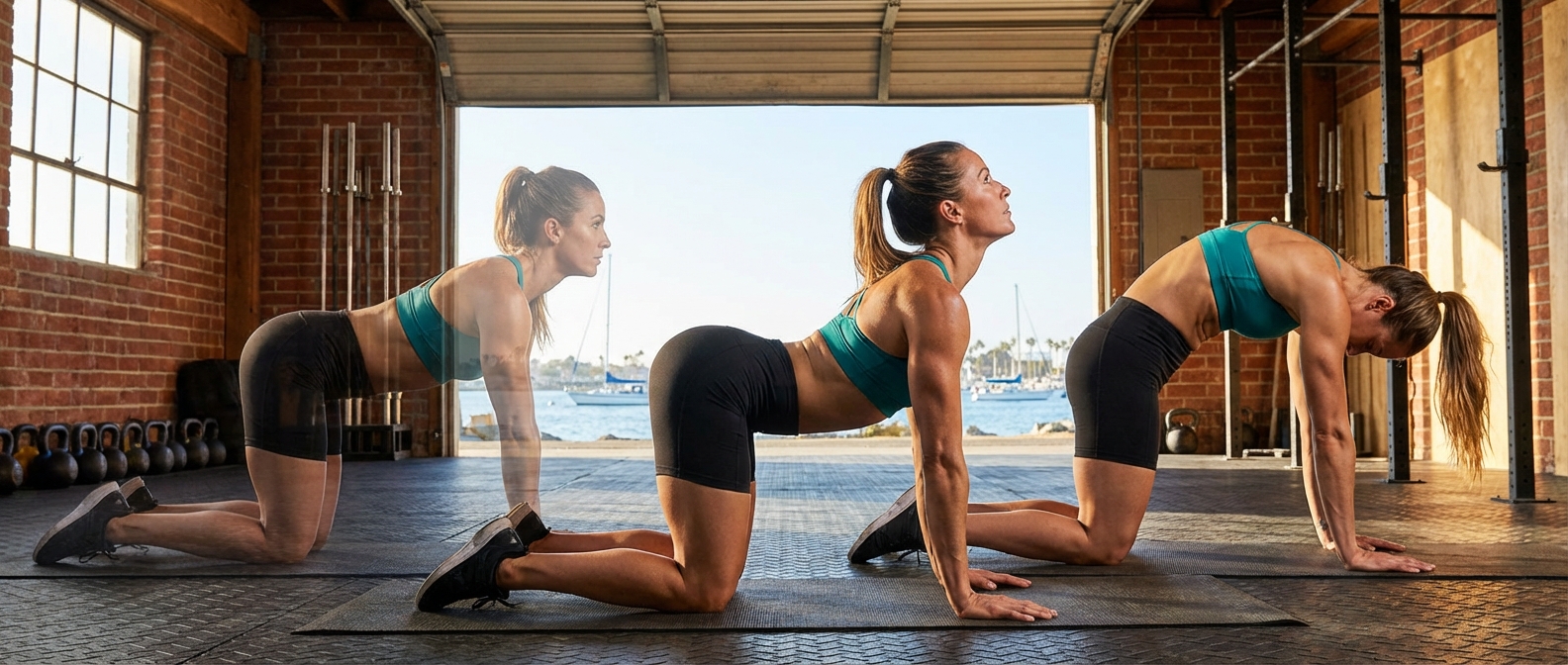
This is a Closed Kinetic Chain (CKC) movement. With hands and knees fixed to the ground, the distal segments are stationary. This allows for controlled mobilization of the proximal segments (pelvis and spine) against the stable base of support provided by the ground reaction forces.
Force Vectors & Gravity
Gravity acts perpendicular to the spine in the quadruped position, creating a shear force. This position unloads the compressive axial forces typically present in standing, allowing for safer manipulation of the intervertebral discs and facet joints through their full range of flexion and extension.
Lumbopelvic Rhythm
The movement decouples the pelvis from the thorax. In the "Cow" phase, anterior pelvic tilt drives lumbar extension. In the "Cat" phase, posterior pelvic tilt initiates lumbar flexion. This re-educates the neuromuscular control of the pelvis, often inhibited by prolonged sitting.
Muscle Map Analysis
While not a hypertrophy exercise, the Cat-Cow requires the coordinated firing of agonists and antagonists to achieve full spinal articulation.
Primary Movers (The "Cat" - Flexion)
Rectus Abdominis & External Obliques: Contract concentrically to pull the rib cage towards the pelvis and flex the lumbar spine.
Primary Movers (The "Cow" - Extension)
Erector Spinae & Multifidus: These deep spinal muscles contract to create extension, fighting the downward pull of viscera.
Stabilizers & Synergists
Serratus Anterior: Protraction of the scapula during the Cat phase.
Lower Trapezius: Depression of the scapula during the Cow phase.
Transverse Abdominis: Maintains intra-abdominal pressure throughout.
Rectus Abdominis
Erector Spinae Group
Serratus Anterior
*Neuromuscular connection is prioritized over load. Focus on the sensation of vertebrae moving individually.*
Execution Protocol
Perform 10 cycles. 1 cycle = 1 Cat + 1 Cow.
The Quadruped Setup
Start on your hands and knees. Ensure your wrists are stacked directly under your shoulders and your knees are stacked directly under your hips. The spine should be in a neutral position (flat back). Spread your fingers wide to increase the base of support.
Inhale: The Cow (Extension)
Initiate the movement from the tailbone. Tilt your pelvis anteriorly (tailbone to the sky). Let your belly sink towards the floor. Draw your shoulders away from your ears and lift your gaze slightly upward.
Biomechanics Note: Avoid hyperextending the neck; keep the cervical spine as an extension of the thoracic curve.
Exhale: The Cat (Flexion)
Tuck your tailbone under (posterior pelvic tilt). Draw your navel toward your spine. Push the floor away with your hands to protract the shoulder blades (spread them apart). Allow the head to drop naturally, looking toward your thighs.
Clinical Corrections
| Error Pattern | The Fix | Biomechanical Consequence |
|---|---|---|
| Hinging at one segment | Visualize the spine as a pearl necklace, moving one pearl at a time. | Creates focal stress points (shear force) rather than distributing motion globally. |
| Bending the elbows | Keep arms straight and locked (but not hyperextended) to isolate spinal movement. | Dissipates the ground reaction force into the triceps rather than the scapular stabilizers. |
| Rushing the tempo | Sync one full movement to one full, deep breath (4-5 seconds per phase). | Fails to engage the parasympathetic nervous system or access end-range mobility. |