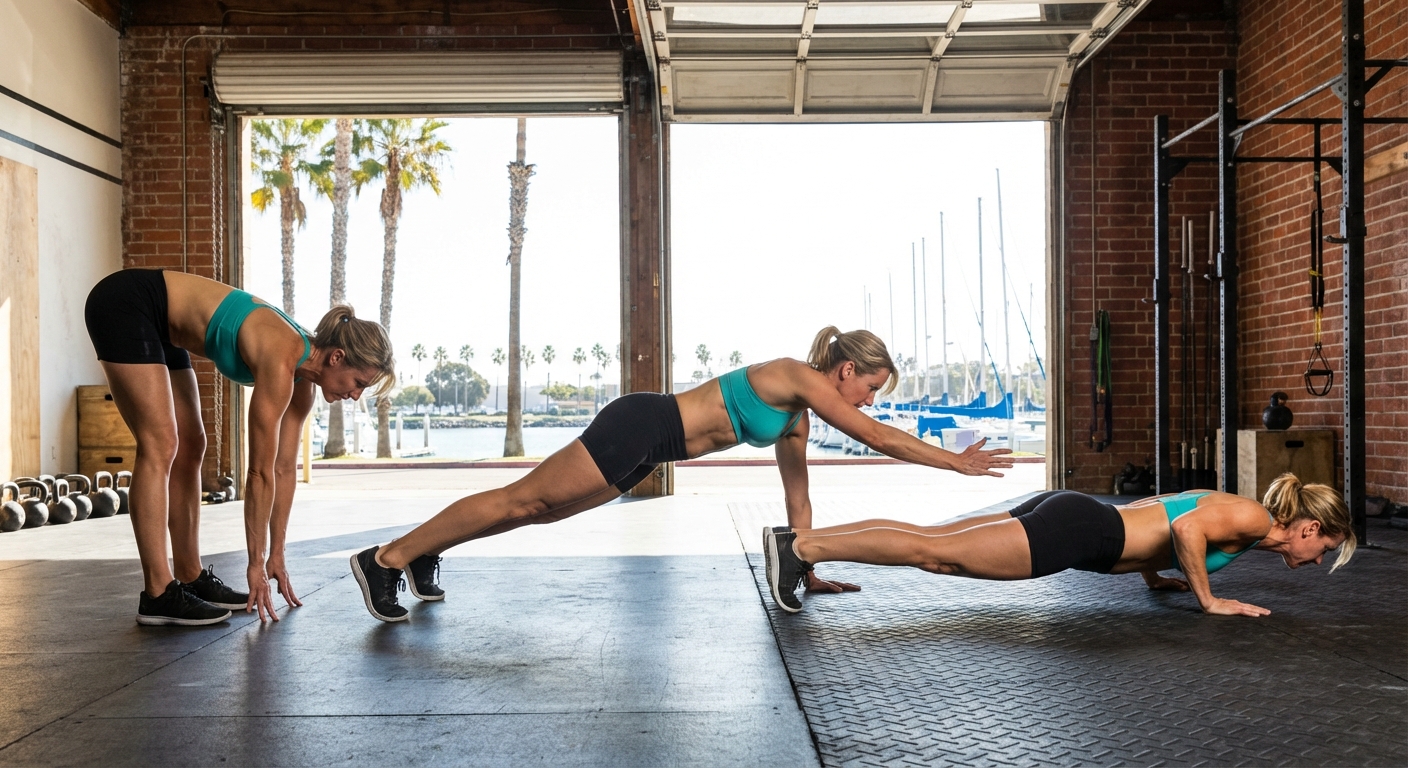
A compound, multi-planar movement integrating posterior chain extensibility with anterior core stability and horizontal pushing strength. This is the gold standard for dynamic warm-ups and metabolic conditioning.
This is a Closed Kinetic Chain (CKC) movement. The distal segments (hands and feet) are fixed to the floor, requiring proximal segments (hips and shoulders) to move. This increases joint compression forces, enhancing proprioception and dynamic stability.
During the "walkout," the lever arm between the center of mass and the support points (feet) lengthens, creating increasing torque on the lumbar spine. The core must generate massive anti-extension force to counteract gravity. The push-up introduces a vertical force vector perpendicular to the spine.
The initiation phase relies on a deep hip hinge. This places the hamstrings under significant passive tension. Proper execution requires disassociating hip flexion from lumbar flexion—maintaining a neutral spine while mobilizing the hip joint.
Pectoralis Major & Anterior Deltoids
Responsible for the horizontal adduction and flexion during the push-up phase.
Triceps Brachii
Elbow extension during the push-up and isometric support during the walkout.
Hamstrings
Undergo dynamic lengthening (eccentric) loading and control the hip hinge.
Coach's Insight: The Serratus Anterior is crucial here. It keeps the scapula glued to the rib cage during the walkout, preventing "winging" and shoulder impingement.
Stand tall, feet hip-width apart. Keeping legs as straight as possible, hinge at the hips to place hands on the floor in front of your feet. Feel the stretch in the hamstrings.
Walk your hands forward. Engage your core progressively harder as you extend. Keep hips steady—imagine a glass of water balanced on your lower back. Stop when you reach a high plank position.
Perform a strict push-up. Lower chest to floor, elbows at a 45-degree angle (arrow shape, not 'T' shape). Drive back up to the high plank without sagging the hips.
Walk your hands back toward your feet. Pike the hips up toward the ceiling. Keep legs straight to maximize the posterior stretch. Return to standing extension before the next rep.
| Error | Biomechanical Consequence | Correction |
|---|---|---|
| Sagging Hips (Lordosis) | Loss of anterior core tension causes compressive shearing forces on the lumbar spine. | Squeeze glutes and brace abs as if expecting a punch. Keep the body rigid. |
| excessive Knee Bend | Reduces the eccentric load on the hamstrings, negating the mobility benefit of the movement. | Keep legs as straight as possible. Widen foot stance if flexibility is limited. |
| Hip Swaying | Indicates a lack of rotary stability and weak oblique engagement during the walkout. | Slow down the hand steps. Focus on keeping hip bones pointing directly at the floor. |
| Shoulder Shrugging | Upper traps taking over due to weak latissimus dorsi/serratus, leading to neck tension. | Pack the shoulders down and back (depression and retraction) away from ears. |
Sources for this exercise are listed on the main exercise page.