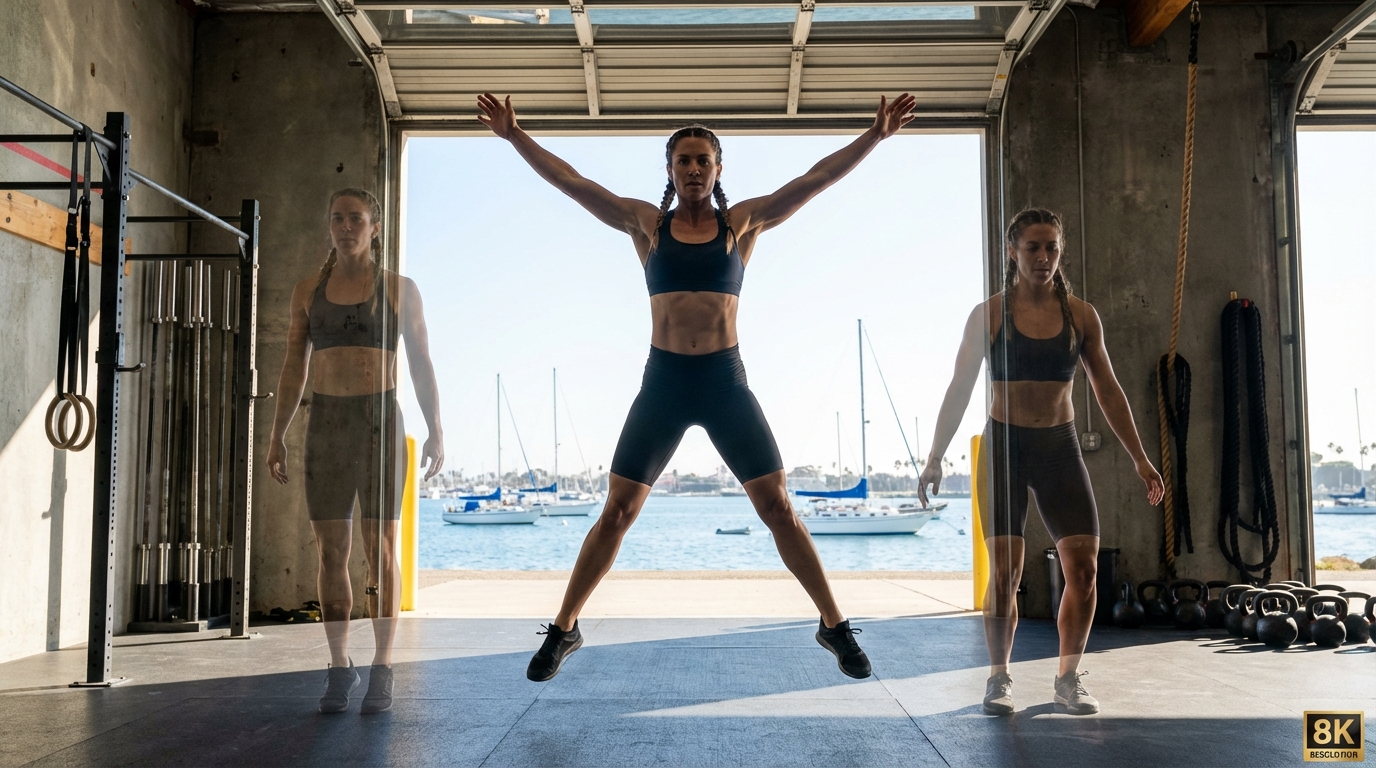
Biomechanics Analysis
The Kinetic Chain
Movement initiates with the Stretch-Shortening Cycle (SSC) of the Achilles tendon. Explosive ankle plantarflexion drives ground reaction force vertically. This force translates into synchronized frontal plane abduction of the glenohumeral (shoulder) and acetabulofemoral (hip) joints.
Vectors & Pivots
Primary Pivots: Shoulder and Hip joints dictate the "X" shape geometry.
Secondary Pivot: Talocrural joint (ankle) handles propulsion and shock absorption.
Vector Management: The body must balance vertical displacement with lateral limb distribution, requiring high rotational stability.
Stabilization Requirements
The Core (Rectus Abdominis, Obliques) acts as an anti-extension mechanism. As arms reach overhead (long lever arm), the rib cage naturally wants to flare; the core must clamp down to maintain a neutral spine. Simultaneously, the Gluteus Medius must fire to prevent knee valgus (inward collapse) upon the lateral landing stance.
Execution Protocols
1. The Anatomical Set
Begin in a standing neutral position. Feet together (medial malleoli touching), arms fully extended at sides, palms facing thighs. Engage the core to set pelvic neutrality.
2. The Propulsion Phase
Initiate movement by plantarflexing the ankles explosively. Simultaneously abduct the legs laterally to slightly wider than shoulder-width and abduct arms in the frontal plane until hands meet or hover directly overhead.
3. The Apex (Star Position)
At the peak of the jump, the body forms an "X". Ensure knees are soft and tracking over the toes (not caving in). The lumbar spine must remain neutral; do not arch the back to get hands higher.
4. The Elastic Return
Adduct hips and shoulders simultaneously to return to the starting position. Land softly on the balls of the feet (metatarsal heads), allowing the ankles to dorsiflex to absorb impact immediately before rebounding into the next rep.
Pathology & Error Correction
| Error | Biomechanical Consequence | The Fix |
|---|---|---|
| Valgus Collapse | Knees caving inward places sheer stress on the MCL and ACL. | Cue "Push knees out" and engage Glute Medius. |
| Lumbar Hyperextension | Rib flare disconnects the core, loading lumbar facets. | Exhale sharply on the jump; keep ribs down. |
| Flat-Footed Landing | Transmits ground reaction force directly to knees/spine. | Stay on balls of feet; keep heels "kissing" the ground. |
| Shoulder Shrug | Overactivates Upper Trapezius, reducing efficiency. | Keep shoulders depressed away from ears. |
Muscle Architecture
- Gastrocnemius/Soleus
- Gluteus Medius
- Deltoids (Lateral)
- Quadriceps
- Hamstrings
- Trapezius
- Rectus Abdominis
- Obliques
Coach's Tip
"Focus on the rhythm. The sound of your feet should be rhythmic and quiet. A loud landing indicates energy leakage and poor shock absorption."