Pike Push-Up
The bridge between horizontal pressing and the vertical handstand push-up.
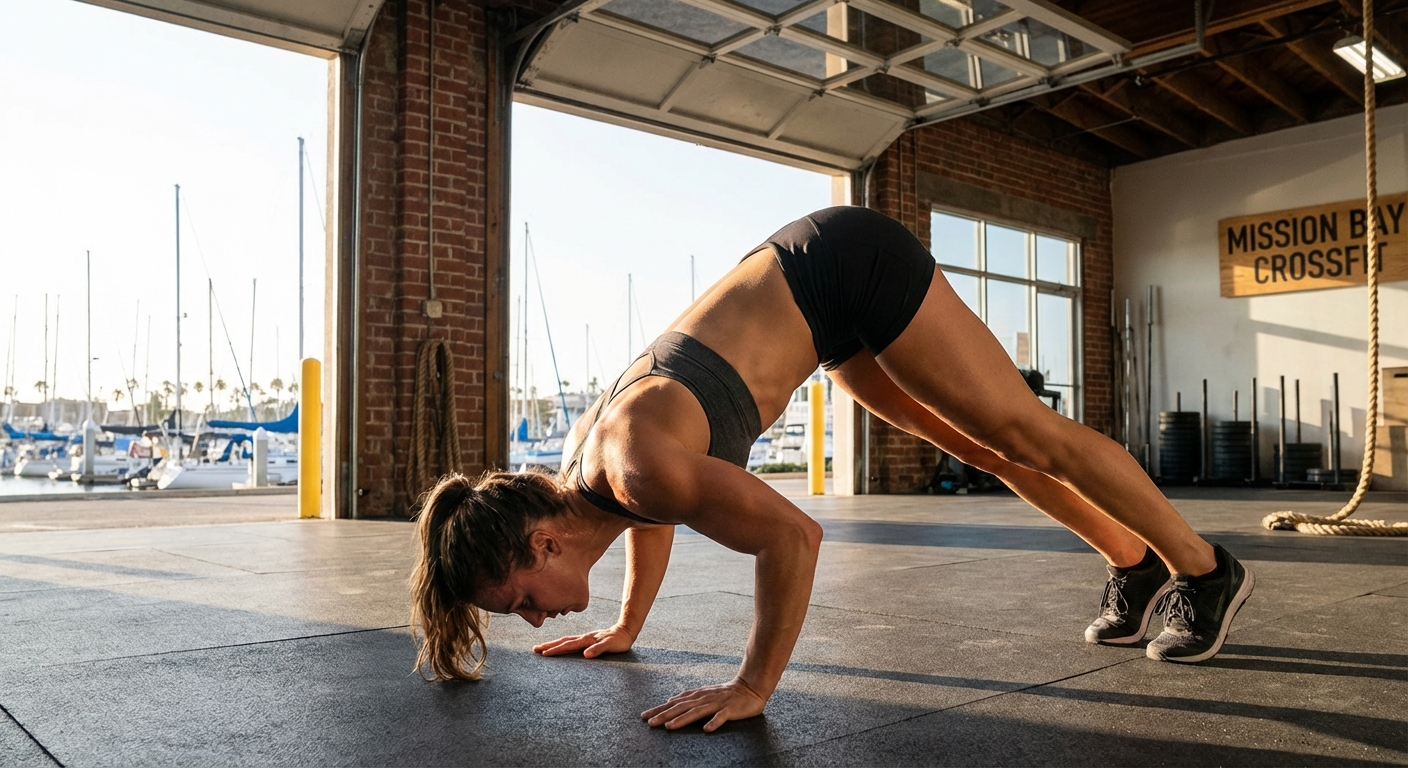
Biomechanics Deep Dive
The Pike Push-Up alters the leverage of a standard push-up by flexing the hips to approximately 90°–110°. This shift transfers the majority of the gravitational load from the pectoralis major to the anterior deltoids and upper trapezius, simulating an overhead press without external weights.
Moment Arms & Torque
The primary moment arm exists between the shoulder joint (fulcrum) and the center of mass projected through the hands. As you descend, the elbows flex and the shoulders translate forward. This creates a large flexion torque (τ) at the shoulder that the Anterior Deltoids must counteract.
The "Tripod" Effect: Proper biomechanics require the head to touch the ground slightly ahead of the hands, forming a triangle. This ensures the forearm remains vertical (minimizing shear force on the elbow) while maximizing the mechanical advantage of the deltoids.
Kinetic Chain Integration
- Shoulder Flexion: As the primary mover, the humerus moves from extension to flexion.
- Scapular Upward Rotation: The Serratus Anterior and Upper Trapezius must rotate the scapula upward to clear space in the subacromial space, preventing impingement.
- Core Integrity: The Rectus Abdominis acts isometrically to prevent lumbar hyperextension, maintaining the inverted "V" shape.
Muscle Map
Primary Movers
The engines driving the vertical force.
- Anterior Deltoid
- Triceps Brachii
- Pectoralis Major (Clavicular Head)
Stabilizers
Essential for safety and force transfer.
- Serratus Anterior
- Upper/Lower Trapezius
- Rotator Cuff
Static Support
Holding the isometric shape.
- Rectus Abdominis
- Hip Flexors (Iliopsoas)
- Quadriceps
Execution Guide
The Setup
Assume a push-up position, then walk your feet forward toward your hands while lifting your hips high. Your body should form an inverted "V" shape. Hands should be shoulder-width apart, fingers spread wide for grip. Keep legs as straight as hamstring flexibility allows.
The Descent
Initiate the movement by bending the elbows. Crucial: Do not drop your head straight down between your hands. Instead, lean forward as you lower yourself. Your head should aim for a point in front of your fingertips, creating a tripod shape (Head + Left Hand + Right Hand).
The Bottom Position
Lower until your head lightly taps the floor or hovers just above it. At this point, your forearms should be vertical (perpendicular to the floor), and your elbows should be tucked at approximately a 45° angle to your torso, not flared out to 90°.
The Ascent
Push firmly through the palms, reversing the motion. Think about pushing your body back and up, returning the head between the biceps. At the very top, perform a slight shrug (scapular elevation) to ensure full range of motion and scapular health.
Common Mistakes Correction
| The Error | The Consequence | The Fix |
|---|---|---|
| Elbow Flare (90°) | Shoulder impingement risk; reduced tricep engagement. | Tuck elbows to 45°. Imagine bending a bar with your hands. |
| Descending Straight Down | Forearms lose verticality; excessive stress on elbows. | Lean forward. Head lands ahead of hands (Tripod). |
| Banana Back (Arching) | Loss of core tension; unfavorable force transfer. | Exhale ribs down. Engage abs. Keep the spine neutral. |
| Looking at the Floor | Cervical spine extension; disrupts balance. | Look through your legs (towards feet) at the top of the rep. |