Rowing
A total-body cyclical power movement requiring precise sequential firing of the lower body, trunk, and upper body musculature.
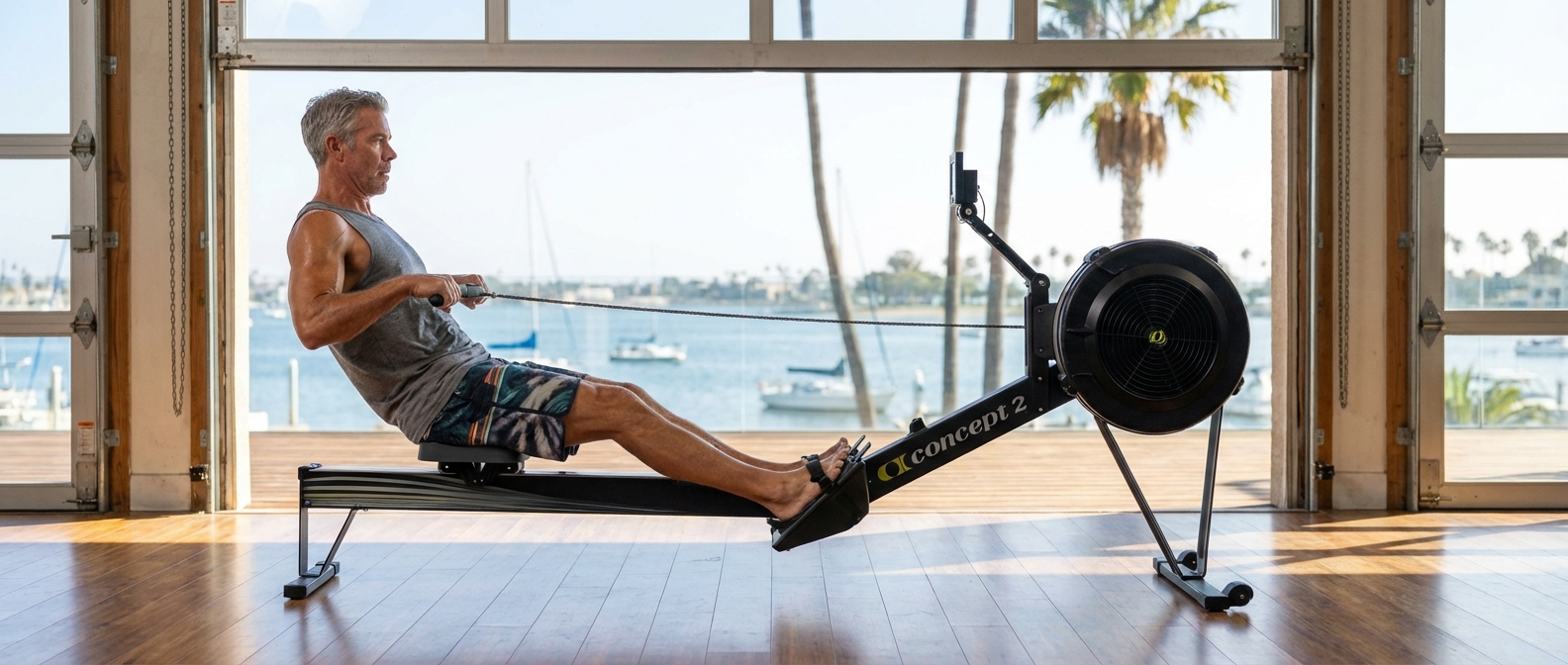
Biomechanics Analysis
Kinetic Chain Sequencing
The rowing stroke is a prime example of summation of forces. Power generation initiates distally at the foot stretcher and transfers proximally.
- 1. Leg Drive (0–60% of Drive): Initiated by explosive Knee Extension (Quadriceps). This is the highest force production phase ($F_{max}$).
- 2. Body Swing (20–80% of Drive): Hip Extension (Glutes/Hamstrings) opens the torso angle from forward flexion.
- 3. Arm Pull (70–100% of Drive): Scapular retraction and Elbow Flexion act as the "finish" to maintain handle velocity.
Lever Systems & Torque
The body acts as a Class 3 lever system during the drive. The Hip Joint serves as the fulcrum.
Note: Effective stabilization is required to transmit the leg power through the torso lever without energy leakage via lumbar flexion.
Muscular Engagement
Primary Movers
High force generation.
- • Quadriceps Femoris
- • Gluteus Maximus
- • Latissimus Dorsi
Secondary Movers
Movement completion.
- • Hamstrings
- • Posterior Deltoids
- • Rhomboids / Trapezius
- • Biceps Brachii
Stabilizers
Force transmission & structure.
- • Erector Spinae
- • Rectus Abdominis
- • Flexor Digitorum (Grip)
- • Tibialis Anterior
Technical Execution
1. The Catch (Setup)
Slide forward until shins are vertical (perpendicular to the rail). Arms are fully extended, reaching past the toes. Torso is flexed forward at the hips to the "11 o'clock" position. Core is braced, lats are engaged.
2. The Drive (Power Phase)
Press heels into the footplate to extend knees explosively. Maintain the forward body angle initially; do not open the hips yet. Once the handle passes the knees, swing the torso open (hip extension) and finally pull the handle to the lower sternum. Think: Push, don't pull.
3. The Finish
Legs are flat, torso is leaning back slightly ("1 o'clock" position). The handle touches the solar plexus lightly with wrists flat and elbows tucked close to the ribs. Shoulders should be down and relaxed, not shrugged.
4. The Recovery
Reverse the sequence: Arms extend away first, then pivot the torso forward from the hips. Once the handle clears the knees, slide the seat forward slowly to return to the catch position. This phase should be relaxed and controlled (ratio 1:2 drive to recovery).
Common Biomechanical Faults
| Error | Biomechanical Consequence | Correction |
|---|---|---|
| Shooting the Slide | Legs extend before the handle moves, causing the seat to shoot back while the handle stays put. Disconnects the kinetic chain. | Visualize the handle and seat moving in unison for the first few inches of the drive. Maintain torso angle. |
| Early Arm Bend | Biceps engage too early, reducing power potential and fatiguing small muscle groups. | Keep arms straight like ropes. Do not bend elbows until the legs are nearly fully extended. |
| Lumbar Flexion (Rounding) | Rounding the lower back at the catch increases shear force on the lumbar spine and reduces force transmission. | Focus on an anterior pelvic tilt at the catch. Sit on your "sit bones," not your tailbone. |
| Over-compressing | Sliding too far forward at the catch (heels lifting excessively) places stress on knee joints and patellar tendons. | Stop the slide when shins are vertical. Do not let the seat hit your heels. |