Hip CARs (Controlled Articular Rotation)
The gold standard for assessing and maintaining femoroacetabular joint health, maximizing capsular space, and training the outer limits of motor control.
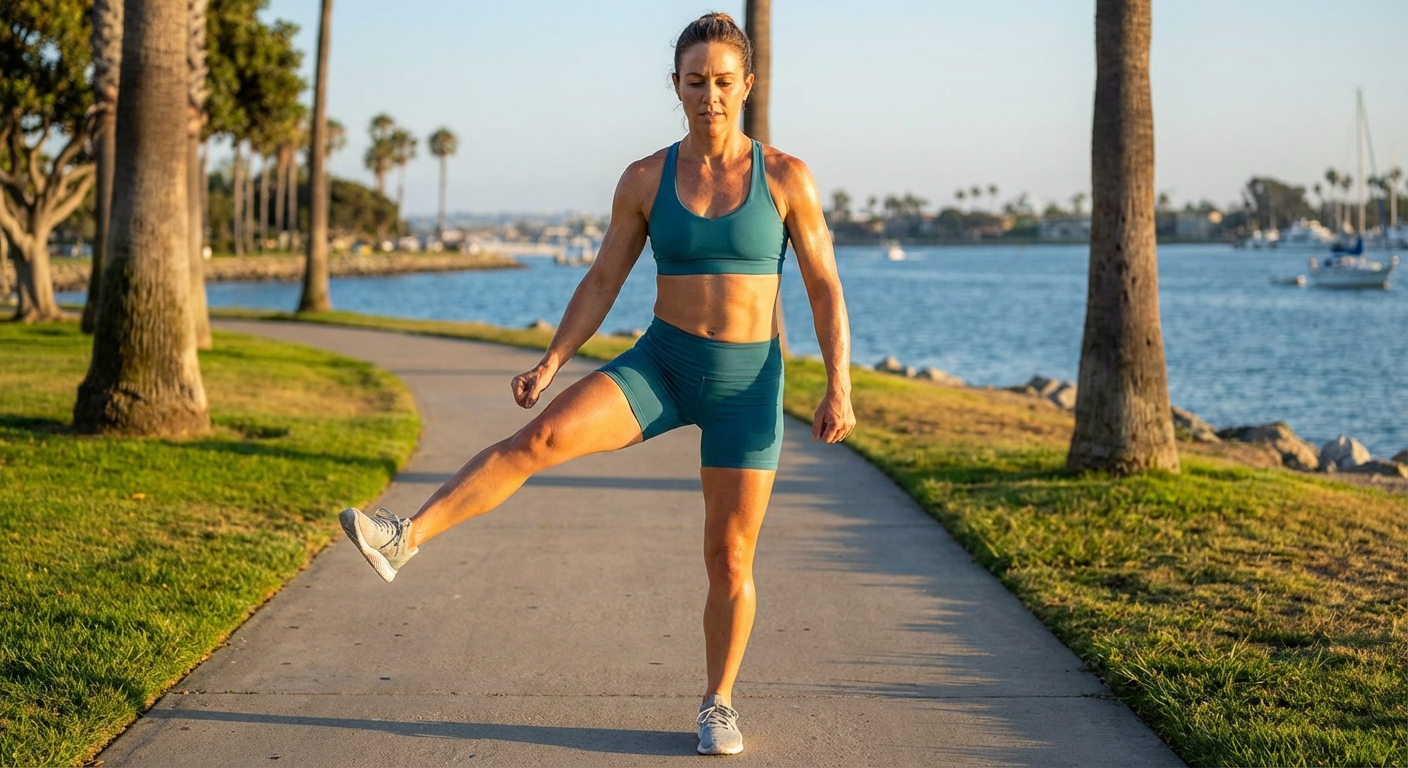
Biomechanics Deep Dive
Joint Kinematics
The hip is a multi-axial ball-and-socket joint (enarthrosis) formed by the femoral head and the acetabulum. CARs prioritize rotational integrity at the outer limits of articular motion. By exploring the full circumference of the joint capsule, we stimulate mechanoreceptors (afferent feedback) and circulate synovial fluid, which is crucial for avascular cartilage nutrition.
Law of Irradiation
Stability dictates mobility. To isolate the femoroacetabular rotation without compensatory lumbar extension, we utilize Sherrington's Law of Irradiation. By gripping the floor with the standing foot and creating tension in the upper limbs, neural drive overflows into the working hip, effectively "locking" the pelvis in place while the femur rotates independently.
Kinetic Chain Analysis
This is a hybrid chain movement. The standing leg operates in a closed kinetic chain (distal segment fixed) providing a stable anchor, while the working leg operates in an open kinetic chain (distal segment free).
- ● Torque (τ): Generated primarily by the deep rotators against the internal resistance of the joint capsule.
- ● Vectors: The force vector shifts constantly through the arc (Flexion → Abduction → Internal Rotation → Extension), requiring rapid sequential firing of agonists.
Muscle Map
Prime Movers (Agonists)
- Flexion: Iliopsoas, Rectus Femoris
- Abduction: Gluteus Medius, TFL
- Internal Rotation: Gluteus Minimus, TFL
- Extension: Gluteus Maximus, Hamstrings
Stabilizers (The Anchor)
- Core: Rectus Abdominis, Obliques (Anti-extension/Anti-rotation)
- Standing Leg: Gluteus Medius (prevents Trendelenburg sign)
- Spine: Erector Spinae (Isometric hold)
Deep Rotators
- Piriformis
- Gemelli (Superior/Inferior)
- Obturator Internus/Externus
- Quadratus Femoris
Execution Protocol
Step-by-Step Sequence
-
1
Setup & Irradiation
Stand next to a wall or rack for balance. Radiate tension throughout the body (30-50% MVC) to lock the ribcage and pelvis. The only thing that should move is the working femur.
-
2
Axial Flexion
Drive the knee up towards the chest as high as possible without rounding the lower back (lumbar flexion). Imagine holding a tennis ball in the hip crease.
-
3
Abduction
Ideally maintaining the height of the knee, open the leg out to the side like a gate. Do not let the opposite hip turn to follow the movement.
-
4
Internal Rotation
This is the crux of the movement. Keep the knee fixed in space and rotate the foot upward/outward. Imagine wringing out a towel within the hip capsule.
-
5
Extension & Adduction
While maintaining that internal rotation, circle the knee backward (extension) behind the body, then bring the knees together to return to the starting position.
-
6
Reverse the Path
Kick back into extension, open the knee out (abduction), externally rotate (dropping the foot, raising the knee), and bring it back to the chest.
Common Mistakes & Corrections
| Error | Biomechanical Consequence | Correction |
|---|---|---|
| Lumbar Extension | Using the lower back to fake hip extension range. | Brace abs harder; monitor ribcage position. |
| Pelvic Rotation | Rotating the whole pelvis instead of just the femur. | Visualize "headlights" on hips facing forward constantly. |
| Knee Flexion Change | Extending/flexing the knee alters the lever arm length. | Lock the knee at 90° throughout the entire rep. |
| Speed (Rushing) | Momentum bypasses the mechanoreceptors at end-range. | Imagine moving through wet concrete. Slow down. |