Hip CARs (Controlled Articular Rotation)
The gold standard for acetabulofemoral hygiene, dissociation, and end-range control.
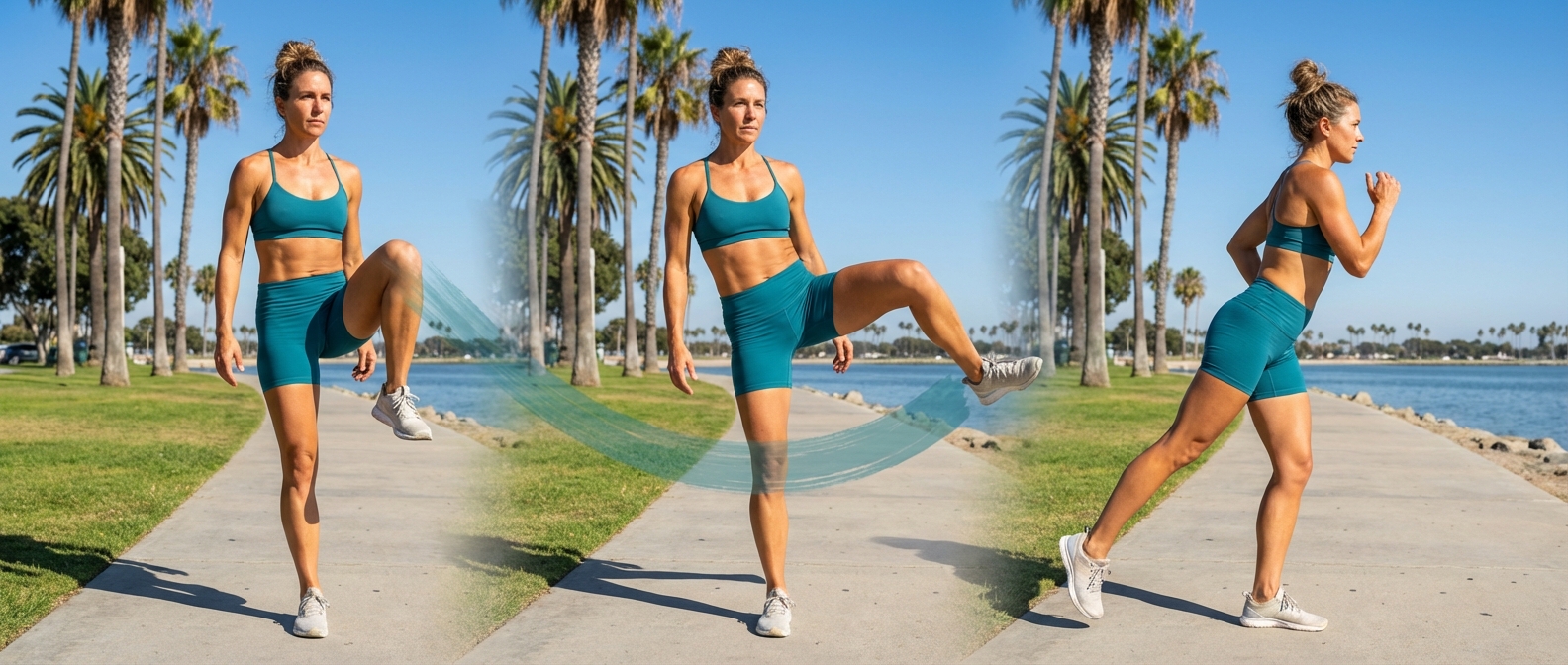
Biomechanics Analysis
The Kinetic Chain
The movement begins at the Plantar Anchor (standing foot), necessitating a locked contralateral knee and engaged glute to create a stable base. Forces transmit upward to provide Acetabulofemoral isolation. The active femur moves through a distinct pathway: Flexion → Abduction → Internal Rotation → Extension.
The spinal column must act as an anti-rotation mechanism. If the lumbar spine extends or the pelvis tilts, the isolation of the ball-in-socket is lost.
Critical Pivots & Axes
Primary Pivot: The femoral head rotating within the acetabulum.
Critical Axis: Femoral axial rotation. The most mechanically demanding portion of the rep occurs at the transition from External Rotation to Internal Rotation, typically when the hip is at θ ≈ 90° abduction. Maintaining the height of the knee while rotating the foot outward is the limiting factor for most athletes.
Stabilization & Irradiation
To isolate the hip capsule, Systemic Irradiation (tension τ > 30%) is required. This "locking" of the Rib-to-Pelvis canister prevents energy leakage. The goal is to decouple the femur from the pelvis; the pelvis should remain frozen in space while the femur traces the widest possible circle at its outer limits.
Muscle Activation Map
Prime Movers
- • Iliopsoas: Hip Flexion
- • Gluteus Medius/Minimus: Abduction
- • Gluteus Maximus: Extension
- • Deep Rotators: Axial Rotation
Stabilizers (Static)
- • Contralateral Glute: Anchors the pelvis.
- • Rectus Abdominis: Prevents rib flare.
- • Quadratus Lumborum: Resists lateral hiking.
Synergists
- • Rectus Femoris: Assists flexion.
- • TFL: Assists abduction/flexion.
- • Adductor Magnus: Stabilizes extension.
Execution Protocol
The Setup (Irradiation)
Stand next to a wall or rack for balance. Grip the floor with your standing foot. Tense your abs, glutes, and grip the support hand. Generate 30% total body tension to freeze the torso.
Flexion to Abduction
Flex the working hip up (knee to chest) without rounding the lower back. Slowly open the gate (abduct) to the side. Maintain the knee height; do not let the foot drop.
Axial Rotation (The Hurdle)
At the limit of abduction, begin to internally rotate the femur. Think of lifting the ankle higher than the knee as you drive the leg backward. The heel should rotate toward the ceiling.
Extension to Neutral
Complete the circle by bringing the knee underneath the hip into extension (squeezing the glute), then return to the starting position next to the standing leg. Reverse the motion smoothly.
Common Pathology & Corrections
| Error | Biomechanical Implication | Correction |
|---|---|---|
| Pelvic Hiking | Compensation via Quadratus Lumborum; faking abduction range. | Visualize a level of water across your waistline that cannot spill. |
| Lumbar Extension | Using spinal erectors to mimic hip extension. | Engage anterior core (ribs down) before extending the hip. |
| Contralateral Knee Bend | Loss of plantar anchor stability; energy leak. | Lock the standing knee and squeeze the standing quad hard. |
| Speed (Rushing) | Utilizing momentum rather than tissue tension. | Slow down. Imagine moving the leg through viscous air or mud. |
Master Your Mobility
Consistent application of CARs maintains joint capsule health and expands usable range of motion.
Return to Exercise Library