TRX Pistol Squat
A definitive guide to mastering the assisted unilateral squat pattern, focusing on knee stability, hip mobility, and anterior chain strength.
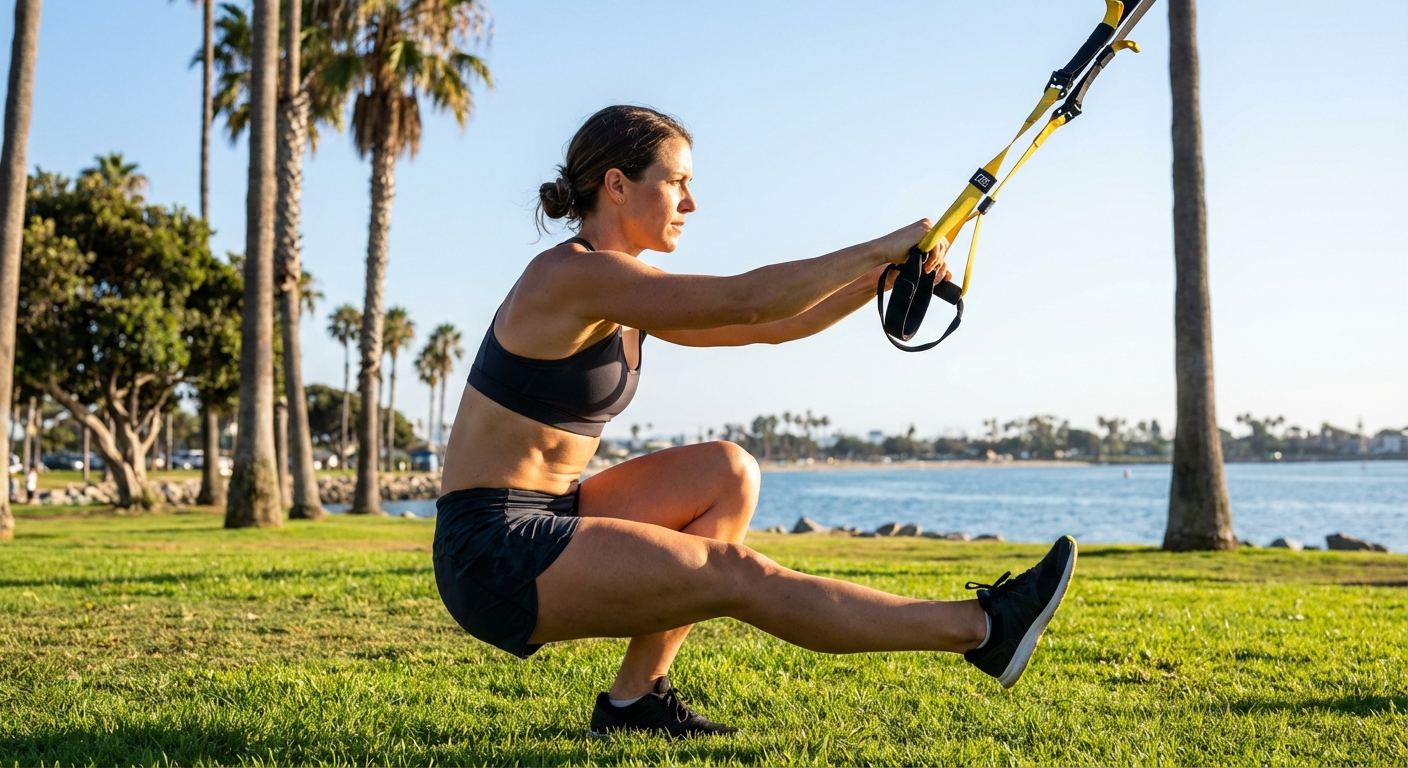
Biomechanics Analysis
Closed Kinetic Chain Dynamics
The TRX Pistol Squat is a unilateral closed kinetic chain movement. Force propagates from the plantar surface of the foot, through the ankle (talocrural joint), into the knee hinge, and finally the hip complex. Unlike a free-standing pistol squat, the TRX creates a "semi-supported" environment. This deloads the posterior chain by distributing a percentage of the load (Vector Ftension) into the suspension straps, altering the absolute torque requirements at the knee joint.
Torque & Pivots
The primary fulcrum is the knee joint. In this movement, the external moment arm is the horizontal distance between the knee joint axis and the line of force (gravity acting on the Center of Mass).
τ = F × d
By leaning back against the TRX straps, the athlete shifts their Center of Mass posterior to the heel. This allows for a more vertical tibia angle (θ) compared to an unassisted pistol squat, reducing shear force on the patellar tendon while maintaining high eccentric demand on the quadriceps.
Planar Stability
The movement occurs primarily in the sagittal plane (flexion/extension). However, stabilization occurs in the frontal and transverse planes. The Gluteus Medius is critical for preventing knee valgus (femoral internal rotation and adduction). The core musculature (Transverse Abdominis) must resist rotation to keep the pelvis square to the anchor point.
Dorsiflexion Requirements
Despite the TRX assistance, significant ankle dorsiflexion is required to keep the heel grounded. If the talocrural joint is restricted (less than 20° dorsiflexion), the athlete will likely compensate by pronating the foot (collapsing the arch) or rounding the lumbar spine to achieve depth.
Muscular Activation Map
Primary Movers
-
Quadriceps Femoris Vastus Lateralis, Medialis, Intermedius, and Rectus Femoris. Primary extensors of the knee.
-
Gluteus Maximus Primary hip extensor, driving the concentric phase out of the hole.
Stabilizers
-
Gluteus Medius Prevents knee valgus and maintains pelvic neutrality.
-
Hip Flexors (Non-working leg) Rectus Femoris and Iliopsoas maintain the elevation of the free leg.
-
Tibialis Anterior Active dorsiflexion to stabilize the ankle joint.
Synergists
-
Adductor Magnus Assists in hip extension at deep angles of flexion.
-
Latissimus Dorsi Isometric contraction helps stabilize the torso via the arm connection.
Step-by-Step Execution
The Setup
Adjust the TRX straps to mid-length. Stand facing the anchor point holding the handles with a neutral grip. Step back until there is no slack in the straps. Center your working leg in alignment with the anchor point. Elevate the non-working leg in front of you, flexing the foot (toes up).
Eccentric Descent
Initiate the movement by simultaneously breaking at the hip and knee. Maintain tension on the TRX straps but avoid pulling yourself up with your arms. Descend slowly (3-4 seconds), keeping the heel of the working foot glued to the floor. Imagine pulling yourself down into the squat rather than just dropping.
The Pocket (Bottom Position)
Reach the point of maximum depth where your hamstring covers your calf. Pause briefly. Ensure the knee tracks over the second and third toe. Do not allow the knee to collapse inward (valgus). Keep the chest proud and spine neutral.
Concentric Drive
Drive forcefully through the midfoot and heel. Exhale as you extend the hip and knee to return to the starting position. Use the arms for assistance only as much as necessary to maintain smooth mechanics. Finish with the hip fully extended, squeezing the glute.
Common Mistakes & Corrections
| Fault | Biomechanical Consequence | Correction |
|---|---|---|
| Knee Valgus (Caving In) | Increases ACL stress and patellofemoral compression forces. Indicates weak Glute Medius. | Cue "push the knee outward" towards the pinky toe. |
| Heel Lift | Shifts load entirely to the knee joint (shear force) and reduces posterior chain activation. | Focus on ankle mobility. Sit back further into the TRX tension to keep the heel down. |
| Over-reliance on Arms | Turns the leg exercise into a back/arm row, reducing the training stimulus on the legs. | Keep a light grip. Use "finger-tip" pressure only. The arms are for balance, not lift. |
| Lumbar Rounding | Compromises spinal integrity ("Butt Wink") usually due to lack of hip flexion mobility. | Limit depth to the point before the pelvis tucks under. Brace the core. |